Helping Families, Small Businesses, and Rural Communities Grow Together
In today’s economy, many people are searching for a simple and affordable way to create extra income. Families are struggling with rising bills, rural hospitals are fighting to stay open, and small businesses are looking for new ways to survive and grow.
What if a one-time $10 investment could become the beginning of something much bigger?
The idea is simple.
You join with a one-time payment of just $10 and personally recruit four active people. Those four people then recruit four active people of their own, and the process continues to grow from person to person.
Many people can easily start with family members, social media friends, coworkers, church groups, or personal contacts.
How the Process Works
When you recruit your four active people:
Your second and fourth recruits go to your sponsor.
Your first and third recruits stay connected to you.
At first glance, giving two recruits to your sponsor may seem unusual, but this structure is what creates the powerful duplication effect that allows everyone to grow together.
As your team members recruit their own people, the growth begins to multiply.
First level earnings can bring in approximately $16.
As duplication continues, the potential increases to $32, then $64, and beyond.
The concept is built around teamwork, sharing, and helping others succeed as the network expands.
A Tool for Helping Small Businesses and Rural Hospitals
Imagine walking into a struggling small business or a rural hospital with only a handful of employees and introducing them to an affordable opportunity that could help generate additional income.
A business owner or administrator could:
Join the program
Invite employees or supporters to participate
Create an additional stream of income
Build stronger financial stability for their organization
As participation grows, the financial impact could grow as well.
This idea is not only about personal income — it is about creating opportunities for communities that need support.
Using Your Income to Help Others
One of the most exciting parts of this opportunity is the ability to help people who are struggling financially.
Additional income could help participants:
Pay bills
Take vacations
Reduce financial stress
Support family members
Help others get started
As income grows, more people can be helped, more businesses can benefit, and more communities can experience positive change.
All beginning with a one-time out-of-pocket cost of only $10.
Start Building Your Future Today
Sometimes the biggest opportunities begin with the smallest steps.
If you are ready to learn more and see how this system works, now is the time to get started.
For decades, Fort Worth has lived in the shadow of its louder neighbor, Dallas. But according to a recent YouTube breakdown of the Panther City, Fort Worth may be one of the most misunderstood major cities in America.
Is it a walkable urban paradise? A sprawling Texas giant? Or somehow both at the same time?
The answer may reveal why Fort Worth continues to quietly grow while holding tightly to its unique identity.
“Where the West Begins”
Fort Worth proudly embraces its nickname, “Where the West Begins.” Unlike many modern cities that abandoned their roots, Fort Worth has intentionally preserved its Western identity through places like the historic Stockyards, rodeos, cattle drives, and classic Texas architecture.
While Dallas often symbolizes modern business and flashy development, Fort Worth leans into authenticity, history, and culture.
Residents often describe the city as more relaxed, more neighborly, and less obsessed with image than other large metropolitan areas in Texas.
The Hidden Urban Success Story
One of the biggest surprises about Fort Worth is how livable its downtown actually feels.
The city has invested heavily in preserving a functional and attractive urban core. Areas like Sundance Square offer walkable streets, public gathering spaces, restaurants, entertainment, and residential growth that many sprawling cities struggle to create.
Local commenters praised the role of influential families and investors, especially the Bass brothers, in helping revitalize downtown Fort Worth into a destination rather than allowing it to decay.
Unlike many American cities that lost their historic downtown identity, Fort Worth managed to maintain a central business district that still feels alive.
A City of Contradictions
Yet despite its urban strengths, Fort Worth is also deeply tied to suburban expansion.
The city stretches across enormous distances with highways, subdivisions, and car-dependent development patterns common throughout Texas. In many ways, Fort Worth represents two cities at once:
A surprisingly walkable downtown
A massive suburban sprawl machine
This contradiction is what makes Fort Worth fascinating. It has managed to preserve pieces of traditional urbanism while still participating in the endless outward growth that defines much of modern Texas.
More Than Cowboys and Oil
Several longtime residents pointed out that Fort Worth’s cultural side is often overlooked.
The city is home to:
World-class museums
A nationally respected zoo
Beautiful parks and public spaces
Historic architecture
Military and aerospace industries
Locals noted that Fort Worth had many of these institutions long before Dallas was competing in the same areas.
The famous Water Gardens, museums, and arts district continue to attract visitors from around the country.
The Spirit of the Panther City
Fort Worth’s “Panther City” nickname comes from an old joke that the city was so quiet a panther could sleep undisturbed in the streets. Instead of rejecting the insult, Fort Worth embraced it.
Today, panther symbols appear throughout the city, including statues, public art, and even the police department badge.
That attitude perfectly reflects Fort Worth itself: confident, resilient, and comfortable being underestimated.
Final Thoughts
Fort Worth may never receive the same national attention as Dallas, Austin, or Houston, but that may be part of its appeal.
It is a city that balances:
Western heritage and modern growth
Urban living and suburban expansion
Cultural sophistication and Texas tradition
Whether you see it as an urban success story or a sprawling contradiction, one thing is clear:
Fort Worth is no longer just Dallas’ quieter neighbor. It has become one of the most unique and complex cities in Texas.
Click Here for an opportunity to increase your income and help others so the same.
Thank you for reading this article. Please share with others,
Rick Herring thmjmj@gmail.com
P.S. Fort Worth is now the tenth largest city in United States.
Running a business is more than making profits, building teams, or reaching goals. For many entrepreneurs and leaders, business is also a spiritual assignment. The question every business owner should ask is this: Who is really leading the company? Is it driven only by human wisdom and ambition, or is God the true CEO?
God Gave Us Authority — But the Power Belongs to Him
From the beginning, God gave mankind authority over the earth, the animals, and the plants. He entrusted humanity with stewardship and responsibility. Yet while we have authority, the ultimate power still belongs to God.
Many business owners work tirelessly trying to carry every burden alone. They make decisions based only on trends, emotions, or financial pressure. But true success comes when we surrender our business plans to God and recognize Him as the Senior Partner.
A successful business is not built merely on strategy — it is built on obedience, wisdom, integrity, and faith.
God as the Senior Partner
When we invite God to be the CEO of our business, we acknowledge that He leads and we follow. We stop asking God to bless our plans and begin asking Him to reveal His plans.
Jesus demonstrated this perfectly during His ministry on earth. He continually submitted Himself to the Father’s will. Jesus said He only did what the Father showed Him to do. His ministry was powerful because it operated in complete partnership with God.
Jesus Christ showed us that surrender is not weakness — it is the pathway to divine power and direction.
What Happens When God Leads Your Business?
When God becomes the CEO of your business:
Decisions are guided by wisdom instead of fear.
Integrity becomes more important than shortcuts.
Employees and customers are treated with love and respect.
Peace replaces constant anxiety.
Purpose becomes greater than profits alone.
This does not mean there will never be challenges. Every business faces obstacles. But when God is leading, you are no longer carrying the vision alone. You are operating under divine guidance and authority.
Surrender Brings Strength
Many people want God to be their helper, but not their leader. Yet partnership with God requires surrender. A CEO has the final authority. If God is truly the CEO of your business, then His values, His timing, and His direction must come first.
That may mean walking away from dishonest opportunities, treating people fairly even when it costs more, or waiting patiently for God’s timing instead of forcing open doors.
Real faith in business is trusting that God’s way produces lasting success.
Final Thoughts
Your business can become more than a source of income — it can become a ministry, a testimony, and a tool for God’s purpose. When you surrender your plans and allow God to lead as the CEO, you position your business for spiritual and practical success.
The world teaches self-reliance, but God teaches partnership.
The authority may be in our hands, but the power still belongs to Him.
Please bring God into your business as the CEO. The Senior and desiding partner for every decision. Every indeaver. Make your business, your life a ministry to bring people closer to God.
What if the next thing to go viral actually helped people?
The “Kindness Virus” is creating buzz online by combining generosity, community, and an income opportunity into one simple concept. For a one-time $150 entry, participants can begin sharing the movement and earn $100 for every person they refer who joins.
The idea is straightforward:
Join the Kindness Virus community
Share it with others
Earn rewards when people you refer participate
In fact, referring just two people puts you into profit.
Supporters say the program is designed to encourage people to spread positivity while creating an opportunity to earn along the way. Whether you’re curious about the concept, looking for a side-income idea, or simply interested in community-driven projects, the Kindness Virus is getting attention fast.
Across America and around the world, a quiet revolution is taking place beneath rows of solar panels. Instead of noisy gasoline-powered lawn mowers, many solar farms are turning to sheep and lambs to keep vegetation under control. The practice, known as “solar grazing,” combines agriculture, renewable energy, and environmental stewardship in one surprisingly simple idea: let sheep do the mowing.
The trend has been growing rapidly in Texas, California, Minnesota, and other states where large solar installations cover thousands of acres. In Texas alone, some solar companies now manage flocks numbering in the thousands. Ranchers who once struggled with declining agricultural markets are finding new income by leasing sheep to solar operators.
Why Sheep Instead of Machines?
Traditional mowing equipment can damage solar panels by throwing rocks or scraping metal supports. Mechanical mowing also requires fuel, maintenance, labor, and repeated trips across large sites. Sheep offer a gentler and more sustainable solution.
Lambs and sheep naturally fit between rows of panels, nibbling grass and weeds in places machinery cannot easily reach. Their grazing reduces vegetation growth that could shade solar panels and lower energy production.
Unlike gas-powered mowers, sheep produce no carbon emissions from fuel use. They fertilize the soil naturally, improve biodiversity, and often reduce the need for herbicides. Solar developers say maintenance costs can drop significantly when grazing replaces mechanical mowing.
A New Opportunity for Ranchers
For many ranchers, solar grazing has become an unexpected lifeline. Some former cotton farmers and struggling livestock operators now earn steady income by supplying sheep to solar farms. One Texas rancher reported earning hundreds of thousands of dollars annually after switching from traditional farming to solar grazing contracts.
The arrangement benefits both sides:
Solar companies save on mowing costs.
Ranchers gain reliable grazing land and new revenue.
Sheep receive shelter beneath solar panels.
Communities benefit from cleaner energy and healthier land management.
The American sheep industry, which has declined for decades, is now seeing renewed interest because of solar grazing demand.
Environmental Benefits Beyond Mowing
Solar grazing is part of a larger movement called “agrivoltaics,” where farmland serves both agricultural and energy purposes. In many locations, solar farms now include pollinator-friendly plants that attract bees and butterflies while sheep maintain the vegetation.
Researchers and environmental groups say sheep grazing can improve soil health, reduce erosion, and support native plant growth. In Minnesota and other states, flocks rotate through solar fields to encourage healthier ecosystems under and around the panels.
Some sites have even added beekeeping operations alongside sheep grazing, turning solar farms into thriving ecological habitats rather than sterile industrial spaces.
The Future of “Lamb Mowers”
As solar energy expands across the United States, the demand for natural vegetation management is expected to grow. Industry experts say solar grazing is no longer a novelty — it is becoming standard practice at many large-scale solar facilities.
The image of lambs peacefully grazing beneath rows of gleaming solar panels captures something larger happening in modern agriculture and energy production. Sometimes innovation does not require more machines or more technology. Sometimes the best solution is one nature perfected long ago.
In an era searching for sustainable answers, the humble sheep may prove to be one of the green economy’s most unlikely heroes.
Please leave your comments. What do you think about lamb mowers?
Rick thmjmj@thmjmj8875
P.S. Click Here to learn how you can spread the Kind Virus and prosper.
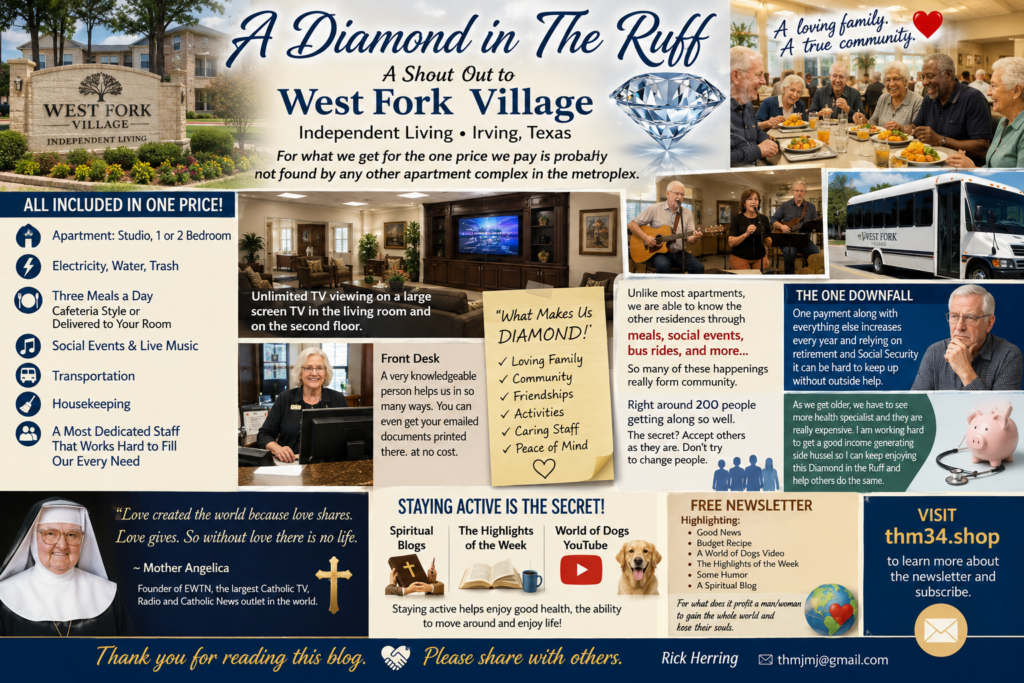
Sunday – I was coming back from Lubbock, so I watched the Mass on EWTN.com.There was a Church Service here a t WFV.
Monday – Doctor’s Appointments all day. I received my first of three Iron Infusions. There was an outing to Saltgrass for lunch.
Tuesday – Errands at 9 AM and 1 PM. Birthday Card signing for those with June Birthdays. At lunch we were served Margaritas in honor of Cinco de May.
Wednesday – Doctor’s Appointments all day. Open Pool Time in the living room.
Thursday – A lady came with her clothes, jewelry, ect. and displayed them in the living room. Mark Dunn entertained with his keyboard and singing for a good hour. We watched the History of Country Music.
Friday – Breakfast at IHOP. Coke Floats. Monthly Newsletter Planning. Jewelry class. Movie Night.
Saturday – The Rosary in the Chapel. There was a Fashion Show featuring some of our ladies showing off some great apparel and talent. One of our ladies won Miss Mature Beauty some years ago and she modeled her attire for that occasion, complete with her Shoulder to waist sash. Another showed off her ability to still twirl the baton.
The day ended with the Hope Group Meeting which featured a dynamic speaker.
As you can see, another great week at West Fork Village in Irving, Texas. A Place Where Seniors Thrive.
The Hope Group Speaker asked what was the best thing that happened to you and all those that spoke said moving to West Fork Village.
If you wish to check out WFV for you or a loved one, call 972 721 1500.
Thank you for reading this blog. Please share with others.
Many people today believe that salvation is automatic. They say, “Jesus died for my sins, so I am
You Are Redeemed — But Salvation Requires Faithful Perseveranc
Introduction
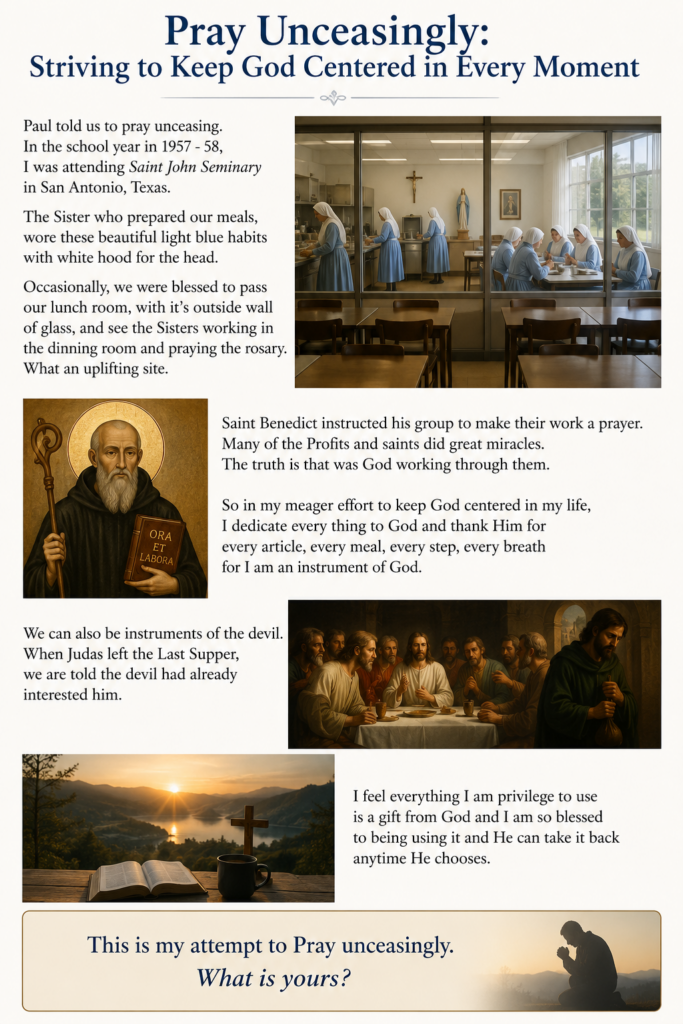
Many people today believe that salvation is automatic. They say, “Jesus died for my sins, so I am saved no matter how I live.” Yet Sacred Scripture teaches something deeper and more demanding.
Yes, by the Passion, Death, and Resurrection of Jesus Christ, humanity has been redeemed. The price has been paid. The door to eternal life has been opened. But salvation is not a one-time declaration spoken with the lips while the heart remains unchanged.
Saint Paul writes:
“Work out your salvation with fear and trembling.” — Philippians 2:12
These words remind us that salvation is not something to take lightly. Redemption was purchased by Christ, but salvation requires cooperation with God’s grace.
The Difference Between Redemption and Salvation
Redemption Is the Gift
When Jesus suffered during His Passion and died upon the Cross, He redeemed mankind. He paid the debt of sin that humanity could never repay.
Scripture says:
“You were bought with a price.” — 1 Corinthians 6:20
That price was the Precious Blood of Jesus Christ.
Through redemption:
Sin no longer has absolute power over humanity.
The gates of Heaven were opened.
Grace became available to all.
Forgiveness became possible.
Redemption is God’s great gift to the world.
Salvation Is the Response
Salvation, however, is our response to that gift.
God does not force anyone into Heaven. He calls us into a living relationship with Him. We must walk with Christ daily, repent of sin, seek holiness, and persevere faithfully until the end.
Jesus Himself said:
“He who endures to the end will be saved.” — Matthew 24:13
Notice the words “will be saved.” Salvation involves endurance, faithfulness, and perseverance.
Faith Must Become Action
Christianity Is Not Passive
Many people want the comfort of faith without the sacrifice of discipleship. Yet Jesus said:
“If anyone would come after me, let him deny himself and take up his cross daily and follow me.” — Luke 9:23
The Christian life is active.
It means:
Loving difficult people.
Forgiving those who hurt us.
Resisting temptation.
Feeding the hungry.
Helping the poor.
Remaining faithful in suffering.
Living in prayer.
Faith that never changes our life is not living faith.
Saint James teaches:
“Faith without works is dead.” — James 2:26
Works do not earn salvation apart from God’s grace, but authentic faith produces obedience, love, and transformation.
Fear and Trembling Before God
Holy Reverence
When Saint Paul says to work out salvation with “fear and trembling,” he does not mean terror without hope. He means holy reverence before Almighty God.
Modern society often treats God casually. Yet Scripture repeatedly teaches reverence.
The fear of the Lord means:
Respect for God’s holiness.
Awareness of our weakness.
Humility before divine judgment.
Gratitude for mercy.
A sincere desire not to offend God.
This holy fear protects us from pride and spiritual laziness.
The Danger of Spiritual Complacency
Do Not Drift Away
One of the greatest spiritual dangers is complacency.
A person may say:
“I was baptized, so I’m fine.”
“I believe in Jesus, so nothing else matters.”
“God understands, so sin is no big deal.”
But Scripture warns believers repeatedly not to fall away.
Saint Paul wrote:
“Therefore let anyone who thinks that he stands take heed lest he fall.” — 1 Corinthians 10:12
Even after redemption, we must continue to seek God daily.
Prayer, repentance, worship, charity, and obedience are not optional parts of Christianity. They are the fruit of a living relationship with Christ.
The Cross Changes Everything
Jesus Calls Us Into Transformation
The Passion of Jesus was not merely an emotional event. It was the greatest act of sacrificial love in human history.
When we truly meditate upon the suffering of Christ:
Pride begins to die.
Selfishness is exposed.
Gratitude grows.
Mercy becomes possible.
Love deepens.
The Cross is not simply something we admire. It is something we enter.
Jesus invites every believer to unite their suffering, struggles, and sacrifices with Him.
Living Redemption Daily
How We Cooperate With Grace
We live out redemption through daily faithfulness.
Some practical ways include:
Daily prayer.
Reading Scripture.
Frequent repentance.
Worship and participation in church.
Serving the poor and forgotten.
Forgiving others.
Rejecting habitual sin.
Seeking peace and holiness.
Every day becomes an opportunity to draw closer to Christ.
Conclusion
Yes, you are redeemed.
Jesus Christ suffered, died, and rose again for you. His mercy is beyond human understanding. His love opened the way to eternal life.
But salvation is not something to treat casually.
We are called to walk faithfully with Christ every day of our lives.
As Saint Paul reminds us:
“Work out your salvation with fear and trembling.” — Philippians 2:12
May we never waste the grace purchased by the Blood of Christ.
May we live with humility, repentance, perseverance, and love.
And may we one day hear the words:
“Well done, good and faithful servant.” — Matthew 25:23
Thank you for reading this blog. Please share with others,
We live in what economists and cultural critics call the Attention Economy — a system in which the most valuable resource is not oil, not gold, not even money, but human attention. Every notification, every headline, every scrolling feed is competing for a single scarce commodity: our focus.
The largest companies in the world have built trillion-dollar empires on this principle. Social media platforms, streaming services, advertisers, and news outlets all profit by keeping us engaged for as long as possible. But there is a problem built into the system: outrage captures attention faster than peace. Fear spreads more quickly than hope. Anger generates more clicks than kindness.
And so the digital world has slowly trained itself to reward negativity.
The result is all around us. People are exhausted. Communities are fragmented. Public discourse often feels less like a conversation and more like a battlefield. The algorithms do not necessarily ask what is true, beautiful, or healing. They ask what will keep people reacting.
But at the edges of this system, something extraordinary is beginning to emerge.
A growing number of people are discovering another way to create value — and another way to earn a living. They are building businesses, communities, and movements not around outrage, but around encouragement, service, creativity, and compassion. They are participating in what might be called the Kindness Economy.
The Kindness Economy begins with a radical but deeply human idea: money is, at its best, a measure of how much you have helped people.
In its purest form, money is not merely compensation for suffering through work you hate. It is not simply a scoreboard for competition. It is the applause that society gives you for making someone’s life better.
When you solve a problem, people reward you.
When you create beauty, people support you.
When you make others feel seen, heard, valued, and less alone, they remember you.
This is not idealism. It is the original foundation of commerce itself.
A farmer grows food that feeds a village. A carpenter builds homes that shelter families. A teacher shares wisdom that changes a child’s future. In every healthy economy, value flows toward those who improve life for others. The Kindness Economy simply restores that principle in a world that has become distracted by spectacle and division.
What makes this moment unique is that technology — the very thing that intensified the Attention Economy — also makes the Kindness Economy possible on a global scale.
Today, one person with sincerity and a smartphone can encourage millions. A small business can thrive by genuinely serving its customers instead of manipulating them. Independent creators can build loyal communities by teaching, uplifting, and inspiring. People no longer need permission from giant institutions to spread goodness. They can do it directly.
And remarkably, kindness scales.
A harsh comment may travel fast, but encouragement travels deep. Cynicism may dominate headlines, but hope changes lives. Every act of generosity creates ripples that move outward through families, friendships, neighborhoods, and entire communities.
This is why kindness is not weakness. It is infrastructure.
A society cannot survive on outrage alone. Trust, cooperation, compassion, and goodwill are forms of social capital every bit as real as financial capital. When they disappear, communities collapse into loneliness and suspicion. But when they grow, human flourishing becomes possible again.
The Kindness Economy recognizes that helping people is not separate from prosperity — it is the foundation of lasting prosperity.
This is where the idea of the Kindness Virus becomes so powerful.
Unlike a biological virus, the Kindness Virus spreads healing instead of harm. One act of compassion inspires another. One generous person gives others permission to be generous too. A smile changes a mood. Encouragement changes a day. Mercy can change a life.
And like all contagious things, kindness multiplies through contact.
The world tells us that competition is the natural law of human existence. But history tells a more complete story. Human beings survived not merely because we competed, but because we cooperated. Civilization itself was built through acts of trust, sacrifice, teaching, caregiving, and shared labor.
The future may belong not to those who capture the most attention, but to those who create the most meaning.
Already, we can see signs of this shift. Customers are choosing businesses that treat people well. Audiences are seeking authenticity over manipulation. Young entrepreneurs increasingly want purpose alongside profit. Communities are hungry for leaders who heal rather than divide.
People are tired of being treated like data points.
They want to be treated like human beings.
The Kindness Economy is not naïve about the existence of evil, greed, or conflict. It simply recognizes that negativity is ultimately unsustainable. Fear may produce short-term engagement, but kindness creates long-term loyalty. Outrage may generate clicks, but trust builds civilizations.
In the years ahead, the most valuable people may not be those who dominate the loudest conversations, but those who help others feel less afraid, less isolated, and more hopeful.
That is not just moral wisdom.
It is economic wisdom.
Because in the deepest sense, wealth has always been relational. The strongest societies are not merely the richest societies. They are the societies where people believe they belong to one another.
The Kindness Economy invites us to build that kind of world again.
One act of service at a time.
One person at a time.
One moment of kindness at a time.
Click Here to become part of the Kindness Economy.
Why Small Acts of Compassion Matter More Than Ever
“You cannot do a kindness too soon, for you never know how soon it will be too late.” — entity[“people”,”Ralph Waldo Emerson”,”American essayist and philosopher”]
In a world moving faster than ever, kindness is often treated as something optional — something we will get around to later when we have more time, more money, or fewer worries. Yet Ralph Waldo Emerson’s timeless words remind us of a truth many people discover too late: opportunities to help others do not last forever.
A kind word left unspoken. A phone call never made. A helping hand delayed until tomorrow. Life changes quickly, and the chance to bless another person can disappear in an instant.
Today, kindness is not merely a pleasant virtue. It is a necessity.
The Quiet Power of Simple Kindness
Many people imagine kindness as grand gestures or dramatic acts of charity. In reality, the most powerful acts are usually the smallest.
A smile to a lonely neighbor.
Listening patiently to someone who feels forgotten.
Paying for a stranger’s coffee.
Helping a struggling small business survive one more week.
Checking on an elderly friend.
Praying for someone carrying hidden pain.
These moments rarely make headlines, yet they often change lives forever.
Kindness has a ripple effect. One act of compassion inspires another. A person who receives mercy is more likely to show mercy. Communities grow stronger when people choose generosity over indifference.
In small towns across America, neighbors helping neighbors still keeps communities alive. Rural hospitals survive because caring people refuse to give up. Families overcome hardship because someone stepped in at the right moment.
Often, the difference between despair and hope is simply knowing that somebody cares.
Why Waiting Can Cost More Than We Realize
Modern culture teaches people to postpone what matters most.
“We’ll visit later.”
“We’ll donate when finances improve.”
“We’ll reconnect someday.”
But tomorrow is never guaranteed.
Every person carries unseen battles. Some struggle with loneliness. Others face illness, grief, financial hardship, addiction, or fear. Many smile outwardly while quietly losing hope.
A timely act of kindness may arrive at the exact moment someone is deciding whether life is worth continuing.
History is filled with stories of lives transformed by one compassionate moment:
A teacher who encouraged a discouraged child.
A stranger who offered food to a hungry family.
A nurse who stayed a few extra minutes beside a frightened patient.
A pastor who answered a late-night phone call.
A veteran who mentored a troubled teenager.
The people involved may never fully know the impact they made.
That is the mystery of kindness: small actions often produce eternal results.
Kindness Is Not Weakness
Some people confuse kindness with softness or naivety. In truth, genuine kindness requires courage.
It takes strength to remain compassionate in a cynical world.
It takes humility to serve others without seeking recognition.
It takes wisdom to see the humanity in people society overlooks.
And it takes faith to keep loving when life becomes difficult.
Kindness is not passive. It is active goodness.
It feeds the hungry.
It comforts the grieving.
It protects the vulnerable.
It rebuilds communities.
It restores dignity.
Throughout history, societies have survived hardship because ordinary people chose compassion over selfishness.
In times of economic uncertainty, social division, and growing loneliness, kindness may be one of the most revolutionary things a person can practice.
Faith, Humanity, and the Call to Love One Another
Across many spiritual traditions, kindness is viewed as sacred.
In Christianity, believers are reminded to love their neighbors, care for the poor, and treat others as they themselves would wish to be treated.
Kindness reflects the belief that every person possesses inherent dignity and worth.
Even brief encounters matter. The cashier at the grocery store. The exhausted waitress. The veteran standing quietly alone. The struggling single parent. The resident in a nursing facility who rarely receives visitors.
Each person carries a story.
Each person matters.
Sometimes the greatest ministry in life is simply showing up for another human being.
A visit.
A prayer.
A meal.
A conversation.
A moment of compassion.
These things may appear small on earth, but they echo far beyond what we can see.
Five Ways to Practice Immediate Kindness Today
1. Reach Out to Someone You Have Been Thinking About
Do not wait for the perfect time. Send the text. Make the call. Visit the person. Your outreach may mean more than you realize.
2. Support a Local Small Business
Many family-owned businesses are struggling quietly. A purchase, positive review, or recommendation can help sustain livelihoods and preserve communities.
3. Encourage Someone Publicly
People remember encouragement for years. Speak life into someone who feels invisible.
4. Volunteer Where the Need Is Greatest
Homeless shelters, rural ministries, food banks, hospitals, and veteran organizations constantly need caring people willing to serve.
5. Practice Daily Compassion
Hold the door. Listen without interrupting. Offer patience instead of irritation. Small habits of kindness shape both individuals and nations.
Final Thoughts
Ralph Waldo Emerson understood something deeply human: opportunities to love others are temporary.
No one reaches the end of life wishing they had shown less compassion.
The world does not simply need more technology, wealth, or influence. It needs more people willing to act with kindness before the moment passes.
A gentle word.
A helping hand.
A compassionate heart.
These simple acts can change lives, strengthen communities, and restore hope in places where darkness has settled.
So do not wait.
Offer the kindness today.
Because you never know how soon it may be too late.