Category: SAint of the Day

  • Saint Patrick


    Biography

    Patrick

    385-464

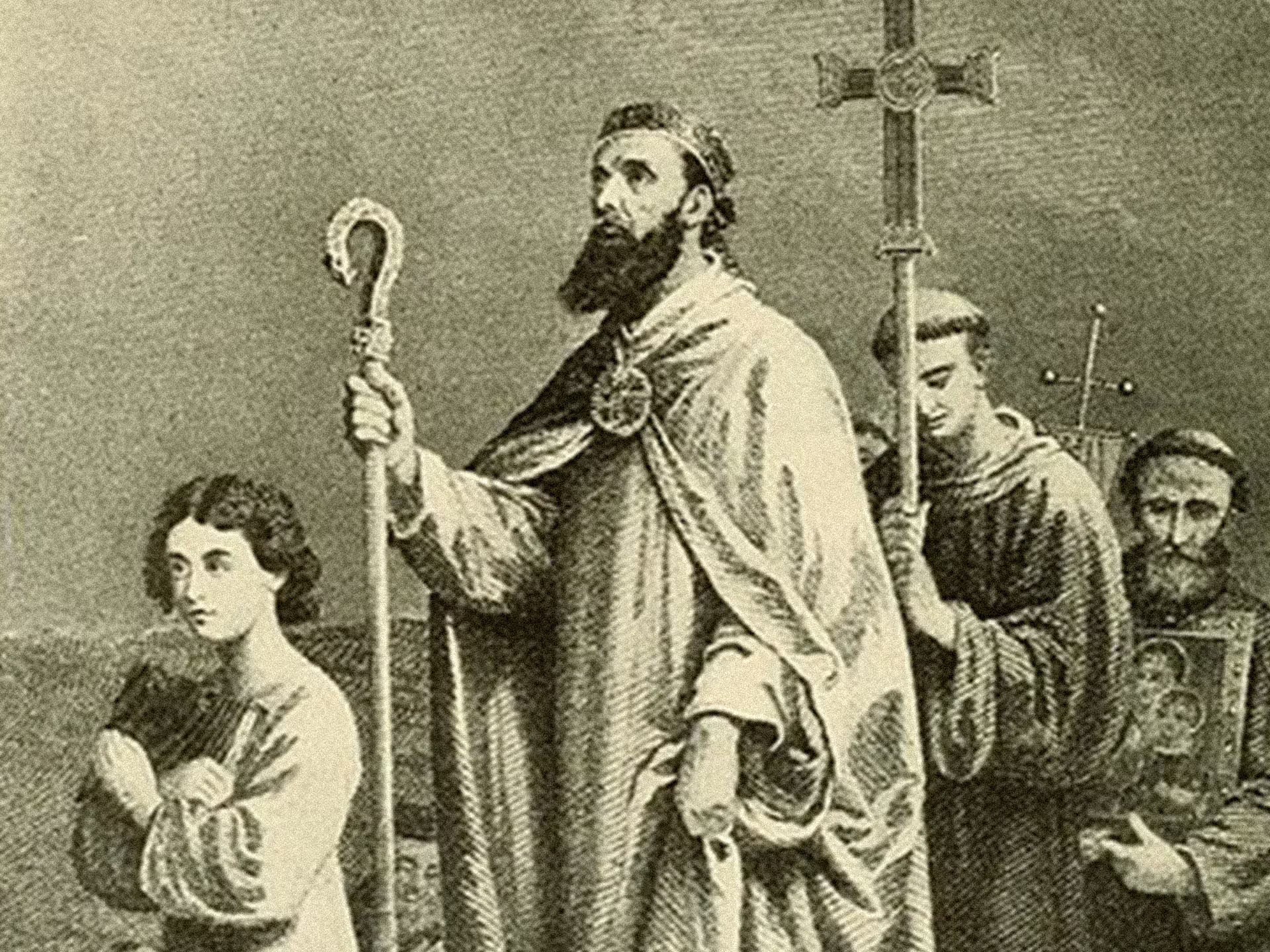
    Patrick was not a green-clad, Irish, Roman Catholic saint. He was a missionary, one willing to lay down his life for the gospel.

    Celtic Culture and Legends

    There is, perhaps, more lore surrounding Patrick, the missionary who brought the good news of Christ to Ireland, than any other missionary in Christian history. In order to understand the real Patrick, we must first understand a little about pre-Patrick Ireland. 

    Ireland was a nation shaped by the polytheistic religion of the druids. They worshiped multiple gods and goddesses associated with natural elements. Sun, water, earth, etc. all had deities connected to them. They were also a hierarchical society, structured around priests, novices, bards, and seers. Each was deeply involved in pagan practice.

    It’s worth debunking some legends and assumptions about Patrick too, like, for example, that he was Irish. Patrick came to Ireland as a missionary, but he was not, in fact, Irish. The real Patrick was abducted by the Irish and enslaved, escaped, and then later returned as a missionary. 

    Other legends include stories that Patrick used the shamrock to teach the Trinity, that he drove the snakes from Ireland, or that he jabbed his staff into the ground and it blossomed into a tree, converting many to Christianity. Although there may be profound truths or metaphors at the roots of these legends, not one is based in fact. Furthermore, the famous “Patrick’s Breastplate” slogan – “Christ be with me, Christ within me, Christ behind me, Christ before me, Christ to me, Christ beneath me, Christ above me” – cannot be attributed to Patrick with any measure of confidence. Finally, despite common usage, “Saint Patrick” was never canonized as a saint in the Roman Catholic Church. 

    The Real Patrick

    So, if “Saint Patrick” wasn’t a saint, wasn’t Irish, and didn’t do the things he’s most well known for, who was he? From his few surviving letters and his Confessio, it seems that Patrick was more like the missionaries we recognize today than the legends would have it. He was a preacher. He used words, not miracles and signs and wonders.

    Patrick was born around 385, and he died sometime between 461 and 464. We know that his family was well to do, but unlike many of his class in those times is that he doesn’t have the same level of education. He was raised in a Christian home. His father, Calpurnius, was a deacon, son of Potitus, a presbyter. We also know that he was from Bannavem Taburniae. Tradition has it that Bannavem Taburniae is in Scotland, Wales, England, or even France, but the exact location has never been found.

    When he was around 16 years old Patrick was enslaved. We’re told that he herded goats, sheep, or swine (possibly added because of the parable of the prodigal son). Of this time, Patrick wrote that, 

    “the Lord opened to me the sense of my unbelief that I might at last remember my sins and be converted with all my heart to the Lord my God, who had regard for my lowest state and pitied my ignorance and youth.” 

    Eventually the newly converted Patrick was able to escape and return to his home by stowing away on a ship. But, perhaps surprisingly, in the time he was away from the Irish people, his heart for the Irish grew. One night he had a vision of man who delivered a letter, “The Voice of the Irish,” which begged him to return to Ireland.  

    Patrick resolved to return to Ireland, but he took time to pursue ministerial preparation and theological training. He spent 12 years studying the scriptures in a French monastery called the monastery of St. Germain. As he prepared to go, he said, “I am ready to be killed, betrayed into slavery or whatever may come my way for the sake of your name.” 
    Return to Ireland

    Patrick returned to Ireland not knowing whether he would have success. He didn’t have modern demographic research, and very little knowledge of the Irish appetite for the gospel, but the Lord blessed his work:

    “For I am greatly God’s debtor, who has granted me such grace that many people through me were reborn to God and afterward confirmed, and that clergy were ordained everywhere for them, for a people newly come to belief, whom the Lord took from the ends of the earth, as he once promised through the prophets… So that even before my death I should see a multitude of peoples born again in God.”

    Despite lacking a corpus of the sermons of Patrick, we know he had success in his ministry as a pastor. Some attribute this to the king, because under Patrick’s ministry the magistrate put to death 800 druid priests who were unwilling to be converted. However, the growth of Celtic Christianity in the years following would suggest something more than political expedience.

    Patrick is buried in Downpatrick in Northern Ireland. A cathedral was built on the site, said to be Patrick’s stone under which he’s buried.

    Celtic Christianity

    The Ireland of Patrick’s day had never been part of the Roman Empire, though its harbors were known to the Romans through trade. It was probably merchants who first brought Christianity to Ireland in the fourth century. In 431, Pope Celestine sent a man named Palladius from Gaul to the Christians in Ireland. Almost nothing is known about Palladius’s role in the spread of Christianity in Ireland. But it’s likely that some Irish already knew something of Christianity even before Patrick arrived.​​ 

    After Patrick’s death, Celtic Christianity continued to flourish for well over 200 years without any involvement from Rome. It was a church in which Scripture was the primary source of authority, guiding the community’s faith and practice. Monasteries, pastors, and elders within the church were connected and there was discussion among them as to what should be going on within the church. They weren’t just developing different thoughts and ideas on their own. There was also an emphasis on personal religion, and there was a missionary zeal, a fervor to spread Christianity. This was a focus on what some would call “all of life Christianity,” their faith affecting their homes, their private lives, their communities, and the state. But this didn’t last forever.

    There was, eventually, a romanizing of Celtic Christianity, at the Synod of Whitby in 664, born from a desire to align with Rome in order to strengthen ties to a broader Christianity. The shift would essentially destroy Celtic Christianity, replacing it with what was in Rome.

    Patrick’s Legacy

    The next time St. Patrick’s Day comes around, remember that Patrick was not a green-clad, Irish, Roman Catholic saint. He was a missionary, one willing to lay down his life for the gospel. One fully committed to the advancement of the gospel through the growth of the church – seeking worship from the voice of the gospel. Patrick was a man of grace.

    As Patrick said so long ago, “I am greatly a debtor to God who has granted me such great grace that many people through me should be reborn to God.”

    “I am ready to be killed, betrayed into slavery or whatever may come my way for the sake of your name.” 

    Additional Resources

    • Read an article debunking myths and telling of Patrick’s life.
    • Read his Confessio.
    • Rick Herring
      thmjmj@gmail.com
  • Saint of the Day

    Saint Joseph, Husband of Mary

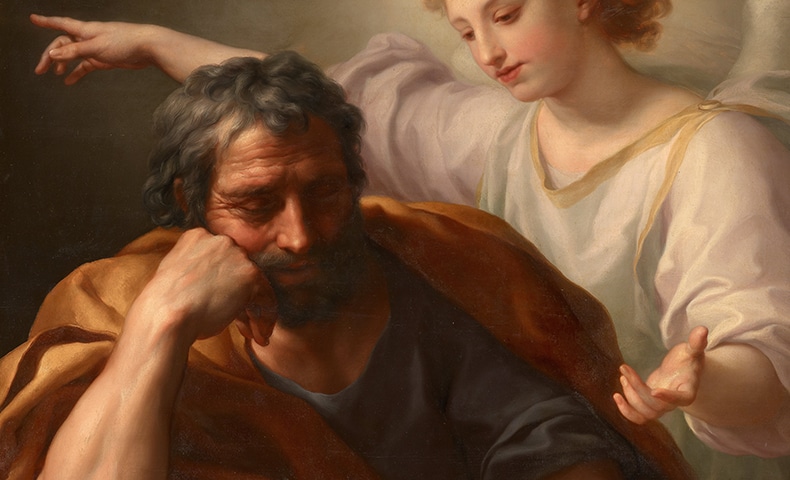
    Painting of Saint Joseph, Husband of Mary talking to an Angel

    Saint of the Day for March 19

    (? – ?)


    Saint Joseph’s Story

    The Bible pays Saint Joseph the highest compliment: he was a “just” man. The quality meant a lot more than faithfulness in paying debts.

    When the Bible speaks of God “justifying” someone, it means that God, the all-holy or “righteous” one, so transforms a person that the individual shares somehow in God’s own holiness, and hence it is really “right” for God to love him or her. In other words, God is not playing games, acting as if we were lovable when we are not.

    By saying Joseph was “just,” the Bible means that he was one who was completely open to all that God wanted to do for him. He became holy by opening himself totally to God.

    The rest we can easily surmise. Think of the kind of love with which he wooed and won Mary, and the depth of the love they shared during their marriage.

    It is no contradiction of Joseph’s manly holiness that he decided to divorce Mary when she was found to be with child. The important words of the Bible are that he planned to do this “quietly” because he was “a righteous man, yet unwilling to expose her to shame” (Matthew 1:19).

    The just man was simply, joyfully, wholeheartedly obedient to God—in marrying Mary, in naming Jesus, in shepherding the precious pair to Egypt, in bringing them to Nazareth, in the undetermined number of years of quiet faith and courage.


    https://youtube.com/watch?v=FSLZaZcsrHs%3Ffeature%3Doembed

    Reflection

    The Bible tells us nothing of Joseph in the years after the return to Nazareth except the incident of finding Jesus in the Temple (Luke 2:41–51). Perhaps this can be taken to mean that God wants us to realize that the holiest family was like every other family, that the circumstances of life for the holiest family were like those of every family, so that when Jesus’ mysterious nature began to appear, people couldn’t believe that he came from such humble beginnings: “Is he not the carpenter’s son? Is not his mother named Mary…?” (Matthew 13:55a). It was almost as indignant as “Can anything good come from Nazareth?” (John 1:46b).


    Saint Joseph is the Patron Saint of:

    Belgium
    Canada
    Carpenters
    China
    Families
    Fathers


    Learn more about Saint Joseph!

    Rick Herring
    thmjmj@gmail.com

  • The Saint of the Day

    Saint Katharine Drexel
    March 3
    Franciscan Media
    Saint of the Day
    Stained glass rendering of Saint Katharine Drexel
    Image: Saint Stephen, Martyr Roman Catholic Church, Chesapeake, Virginia | Stained glass of Saint Katharine Drexel | photo by Nheyob
    Saint of the Day for March 3
    (November 26, 1858 – March 3, 1955)


    Saint Katharine Drexel’s Story


    If your father is an international banker and you ride in a private railroad car, you are not likely to be drawn into a life of voluntary poverty. But if your mother opens your home to the poor three days each week and your father spends half an hour each evening in prayer, it is not impossible that you will devote your life to the poor and give away millions of dollars. Katharine Drexel did that.

    Born in Philadelphia in 1858, she had an excellent education and traveled widely. As a rich girl, Katharine also had a grand debut into society. But when she nursed her stepmother through a three-year terminal illness, she saw that all the Drexel money could not buy safety from pain or death, and her life took a profound turn.

    Saint Katharine Drexel had always been interested in the plight of the Indians, having been appalled by what she read in Helen Hunt Jackson’s A Century of Dishonor. While on a European tour, she met Pope Leo XIII and asked him to send more missionaries to Wyoming for her friend Bishop James O’Connor. The pope replied, “Why don’t you become a missionary?” His answer shocked her into considering new possibilities.

    Back home, Katharine visited the Dakotas, met the Sioux leader Red Cloud and began her systematic aid to Indian missions.

    Saint Katharine Drexel could easily have married. But after much discussion with Bishop O’Connor, she wrote in 1889, “The feast of Saint Joseph brought me the grace to give the remainder of my life to the Indians and the Colored.” Newspaper headlines screamed “Gives Up Seven Million!”

    After three and a half years of training, Mother Drexel and her first band of nuns—Sisters of the Blessed Sacrament for Indians and Colored—opened a boarding school in Santa Fe. A string of foundations followed. By 1942, she had a system of black Catholic schools in 13 states, plus 40 mission centers and 23 rural schools. Segregationists harassed her work, even burning a school in Pennsylvania. In all, she established 50 missions for Indians in 16 states.

    Two saints met when Saint Katharine Drexel was advised by Mother Cabrini about the “politics” of getting her order’s Rule approved in Rome. Her crowning achievement was the founding of Xavier University in New Orleans, the first Catholic university in the United States for African Americans.

    At 77, Mother Drexel suffered a heart attack and was forced to retire. Apparently her life was over. But now came almost 20 years of quiet, intense prayer from a small room overlooking the sanctuary. Small notebooks and slips of paper record her various prayers, ceaseless aspirations, and meditations. She died at 96 and was canonized in 2000.

    Reflection


    Saints have always said the same thing: Pray, be humble, accept the cross, love and forgive. But it is good to hear these things in the American idiom from one who, for instance, had her ears pierced as a teenager, who resolved to have “no cake, no preserves,” who wore a watch, was interviewed by the press, traveled by train, and could concern herself with the proper size of pipe for a new mission.

    These are obvious reminders that holiness can be lived in today’s culture as well as in that of Jerusalem or Rome. Saint Katharine Drexel reminds us that holiness can take many paths, but all of them lead to God. Saint Katharine Drexel: Pray for us!

    Click here for more on Saint Katharine Drexel!

    Rick Herring
    thmjmj@gmail.com

  • Saint John Bosco

    Rick Herring

    Rick Herring

    3 min read

    ·

    Just now

    We are proud of our family: nearly 30,000 religious men and women, and an “army” of dedicated lay folk with whom we march and with whom we share mission and calling. You might even find yourself somewhere in our family. And, we would like that very much.

    A Short Biography of St. John Bosco

    Born in Castlenuovo d’Asti on August 16, 1815, John was educated in the faith and in living according to the Gospel message by his mother. He was just nine years old when he had a dream, which called him to dedicate himself to the education of young people. While still a boy, he began to entertain his peers with games alternated with work, prayer and religious education.

    On becoming a priest (1841), he chose as his life’s programme: “Da mihi animas cetera tolle” (“Give me souls, take all the rest” Gen. 14: 21). He began his apostolate among poor young people with the founding of the Oratory, which he placed under the patronage of St. Francis de Sales.

    He led young people to meet Christ by means of his educational style and pastoral practice, based on reason, religion and loving kindness (the Preventive System). He led young people to reflect, to meet Christ and their brothers and sisters, to the study of the faith and to apostolic, civil and professional commitment. St. Dominic Savio stands out among the most outstanding fruits of his work.

    The source of his indefatigable activity and of the effectiveness of his work was his “constant union with God” and his unlimited confidence in Mary Our Help who he considered to be the inspiration and support of his whole work.

    Work and Temperance

    He left, as an inheritance for his Salesian sons and daughters, a form of religious life that was simple but founded on solid Christian virtue and on contemplation in action, which may be summed up in the words “work and temperance.”

    He sought his best collaborators among his young people, thus establishing the Society of St. Francis de Sales (Salesians). Together with St. Maria Domenica Mazzarello, he founded the Institute of the Daughters of Mary Help of Christians (Salesian Sisters).

    Finally, together with good and hard-working lay men and women, he created the Salesian Cooperators to work alongside him and sustain the education of young people, thus anticipating new forms of apostolate in the Church. In the centenary of his death, which took place on January 31, 1888, Pope John Paul II proclaimed him The Father and Teacher of Youth.

    “No one did more in the last century for so many people than Don Bosco, not only by his personal influence but also by the apostolate of his marvelous Sons.” — Cardinal Spellman

    Explore more about us…

    History of the Salesians

    The Salesian Family

    Our Mission is to help young people break the dire chains of poverty and become self-sufficient, contributing members of society.

    Salesian Missions
    2 Lefevre Lane
    New Rochelle, NY 10801–5710
    Phone: 914.633.8344
    Fax: 914.633.7404
    info@salesianmissions.org