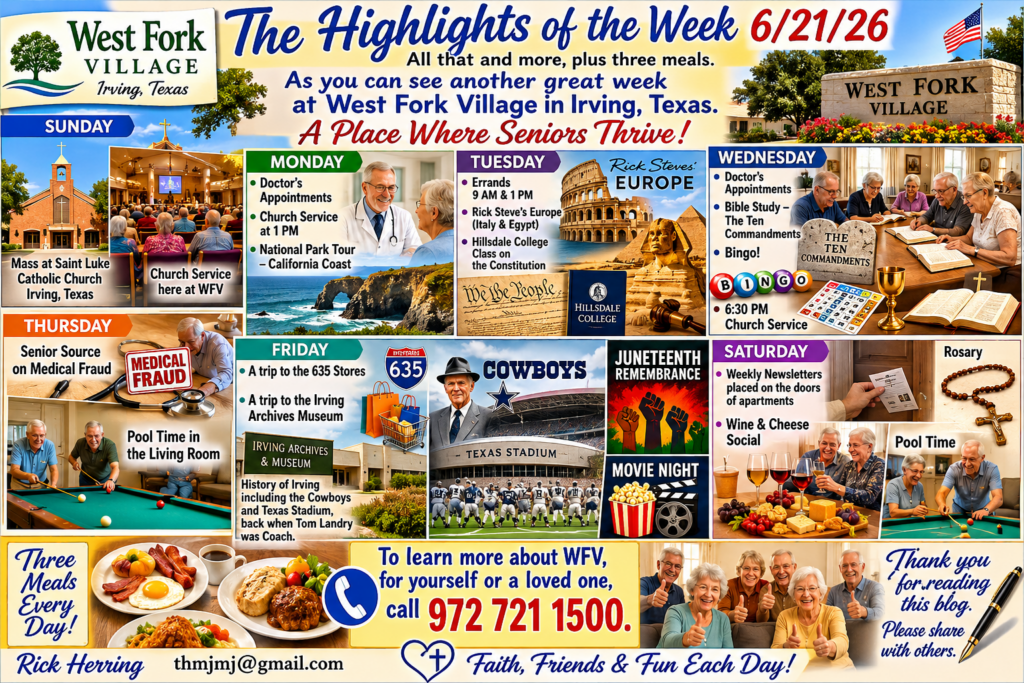
Sunday – I went to Mass at Saint Luke Catholic Church in Irving, Texas. There was a Church Service here at WFV.
Monday – There was a Doctor’s Appointment. Church Service at 1 PM and a National Park Tour, where we viewed the Park off the coast of California.
Tuesday – Errands at 9 AM and 1 PM. Rick Steve’s Europe, where we toured Italy and Egypt and the Hillsdale College Class on the Constitution.
Wednesday – Doctor’s Appointments. Bible Study where we are studying The Ten Commandments,. Bingo and a 6:30 PM Church Service.
Thursday – Senior Source on Medical Fraud and Pool Time in the Living Room.
Friday – A trip to the 635 Stores and a trip to the Irving Archives Museum where we view the History of Irving, which included the Cowboys and Texas Stadium, back when Tom Landry was Coach. Juneteenth Remembrance and Movie Night.
Saturday – The Weekly Newsletters were placed on the doors of apartments. Rosary. A Wine and Cheese Social and Pool Time.
All that and more, plus three meals. AS you can see another great week at West Fork Village in Irving, Texas. A Place Where Seniors Thrive.
To learn more about WFV, for yourself or a loved one, call 972 721 1500.
Thank you for reading this blog. Please share with others.
For decades, Fort Worth has lived in the shadow of its louder neighbor, Dallas. But according to a recent YouTube breakdown of the Panther City, Fort Worth may be one of the most misunderstood major cities in America.
Is it a walkable urban paradise? A sprawling Texas giant? Or somehow both at the same time?
The answer may reveal why Fort Worth continues to quietly grow while holding tightly to its unique identity.
“Where the West Begins”
Fort Worth proudly embraces its nickname, “Where the West Begins.” Unlike many modern cities that abandoned their roots, Fort Worth has intentionally preserved its Western identity through places like the historic Stockyards, rodeos, cattle drives, and classic Texas architecture.
While Dallas often symbolizes modern business and flashy development, Fort Worth leans into authenticity, history, and culture.
Residents often describe the city as more relaxed, more neighborly, and less obsessed with image than other large metropolitan areas in Texas.
The Hidden Urban Success Story
One of the biggest surprises about Fort Worth is how livable its downtown actually feels.
The city has invested heavily in preserving a functional and attractive urban core. Areas like Sundance Square offer walkable streets, public gathering spaces, restaurants, entertainment, and residential growth that many sprawling cities struggle to create.
Local commenters praised the role of influential families and investors, especially the Bass brothers, in helping revitalize downtown Fort Worth into a destination rather than allowing it to decay.
Unlike many American cities that lost their historic downtown identity, Fort Worth managed to maintain a central business district that still feels alive.
A City of Contradictions
Yet despite its urban strengths, Fort Worth is also deeply tied to suburban expansion.
The city stretches across enormous distances with highways, subdivisions, and car-dependent development patterns common throughout Texas. In many ways, Fort Worth represents two cities at once:
A surprisingly walkable downtown
A massive suburban sprawl machine
This contradiction is what makes Fort Worth fascinating. It has managed to preserve pieces of traditional urbanism while still participating in the endless outward growth that defines much of modern Texas.
More Than Cowboys and Oil
Several longtime residents pointed out that Fort Worth’s cultural side is often overlooked.
The city is home to:
World-class museums
A nationally respected zoo
Beautiful parks and public spaces
Historic architecture
Military and aerospace industries
Locals noted that Fort Worth had many of these institutions long before Dallas was competing in the same areas.
The famous Water Gardens, museums, and arts district continue to attract visitors from around the country.
The Spirit of the Panther City
Fort Worth’s “Panther City” nickname comes from an old joke that the city was so quiet a panther could sleep undisturbed in the streets. Instead of rejecting the insult, Fort Worth embraced it.
Today, panther symbols appear throughout the city, including statues, public art, and even the police department badge.
That attitude perfectly reflects Fort Worth itself: confident, resilient, and comfortable being underestimated.
Final Thoughts
Fort Worth may never receive the same national attention as Dallas, Austin, or Houston, but that may be part of its appeal.
It is a city that balances:
Western heritage and modern growth
Urban living and suburban expansion
Cultural sophistication and Texas tradition
Whether you see it as an urban success story or a sprawling contradiction, one thing is clear:
Fort Worth is no longer just Dallas’ quieter neighbor. It has become one of the most unique and complex cities in Texas.
Click Here for an opportunity to increase your income and help others so the same.
Thank you for reading this article. Please share with others,
Rick Herring thmjmj@gmail.com
P.S. Fort Worth is now the tenth largest city in United States.
The Texas Caprock: Where the Land Tells Its Story
Introduction
Rising like a quiet sentinel across the Texas Panhandle, the Texas Caprock is one of the most striking natural features in the Lone Star State. More than just a geographic boundary, it is a place where history, culture, and rugged beauty come together. For Texans and travelers alike, the Caprock offers a glimpse into a land shaped by time, wind, and resilience.
A Land Divided: What Is the Caprock?
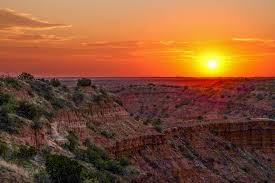
The Caprock Escarpment forms a natural dividing line between two distinct regions: the High Plains (Llano Estacado) to the west and the rolling plains to the east. Stretching roughly 200 miles from the Texas Panhandle down toward Central Texas, this dramatic rise in elevation creates breathtaking views and unique ecosystems.
Standing atop the Caprock, you can look out across vast open spaces that seem to stretch forever. It’s a reminder of how big—and how beautiful—Texas truly is.
Nature’s Masterpiece
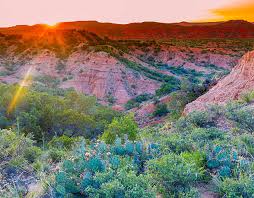
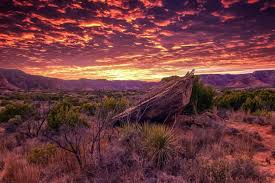
The Caprock is home to diverse plant and animal life adapted to its sometimes harsh conditions. Mesquite trees, prickly pear cactus, and hardy grasses dominate the landscape, while wildlife such as mule deer, coyotes, and wild turkeys roam freely.
One of the best places to experience this environment is Caprock Canyons State Park, where red rock formations and deep canyons create a stunning contrast against the wide blue sky.
The park is also home to the official Texas State Bison Herd, a living symbol of the American West and a powerful reminder of the region’s natural heritage.
A Rich Cultural History
Long before modern roads and towns, Native American tribes such as the Comanche and Apache called this region home. They followed buffalo herds across the plains and used the escarpment as a natural landmark.
Later, during the era of westward expansion, the Caprock became part of the frontier experience. Ranchers, settlers, and cowboys carved out lives in this rugged land, contributing to the enduring spirit of independence associated with Texas.
Why the Caprock Still Matters Today
Today, the Caprock is more than a scenic destination—it’s a place of reflection and renewal. Whether you’re hiking its trails, watching a sunset paint the cliffs in shades of gold and red, or simply standing in silence, the land invites you to slow down and take it in.
For photographers, nature lovers, and those seeking peace, the Caprock offers something rare: a connection to both the past and the present.
Conclusion
The Texas Caprock is not just a geographic feature—it’s a story written in stone, wind, and time. It speaks of endurance, beauty, and the deep roots of Texas history. Whether you visit for a day or simply learn about it from afar, the Caprock leaves an impression that stays with you.
Thank you for reading this article. Please share with others.