“The prayer that flowed directly from the Heart of Christ”
🌿 A Revelation in Troubled Times
In the early 20th century, as the world trembled on the brink of war and moral uncertainty, a humble Polish nun named Saint Faustina Kowalska received extraordinary revelations that would echo across the globe.
Born in 1905, Faustina entered the Congregation of the Sisters of Our Lady of Mercy. She lived a quiet, hidden life—but her soul was chosen for a profound mission. Beginning in 1931, she began to receive visions of Jesus Christ, who appeared to her as the Divine Mercy.
In one of these visions, Jesus asked that an image be painted with the words: “Jesus, I trust in You.”
From His heart flowed two rays—one pale, one red—symbolizing blood and water, the fountain of mercy for all humanity.
✨ The Chaplet: A Prayer Given by Jesus
On September 13, 1935, Faustina recorded in her diary a powerful new prayer—given directly by Jesus Himself. This would become known as the Chaplet of Divine Mercy.
Unlike traditional prayers developed over centuries, this chaplet is unique. According to Faustina’s writings, the words were dictated by Christ:
“Say unceasingly the chaplet that I have taught you… Whoever will recite it will receive great mercy at the hour of death.”
The prayer is prayed using ordinary rosary beads, but its words are striking:
“Eternal Father, I offer You the Body and Blood, Soul and Divinity…”
“For the sake of His sorrowful Passion, have mercy on us and on the whole world.”
Many faithful believe this may be among the only prayers ever given word-for-word by Jesus for mankind to use—making it a deeply intimate connection between Heaven and Earth.
🌍 Spreading the Message to the World
Faustina’s diary, later published as “Divine Mercy in My Soul,” became the foundation of the devotion. However, the message did not spread easily at first. There were misunderstandings and even temporary restrictions placed on the devotion.
But God’s timing is perfect.
A fellow Pole, Pope John Paul II, played a crucial role in bringing the message to the world. Having lived through the horrors of World War II, he deeply understood the need for Divine Mercy.
In the year 2000, he canonized Faustina and established Divine Mercy Sunday—to be celebrated on the Sunday after Easter.
Today, the Chaplet is prayed around the world, especially at 3:00 PM—the Hour of Mercy, the time of Christ’s death on the Cross.
💖 Why the Chaplet Matters Today
In a world still marked by suffering, division, and uncertainty, the Chaplet of Divine Mercy offers something timeless:
Hope for sinners
Comfort for the dying
Peace for troubled hearts
A reminder that God’s mercy is greater than any sin
Jesus promised Faustina:
“The greater the sinner, the greater the right he has to My mercy.”
This message is not one of judgment—but of invitation.
🙏 A Prayer for Our Time
The Chaplet of Divine Mercy is simple. It can be prayed anywhere—alone, with family, or for the whole world.
It is a prayer of offering, of trust, and of surrender.
Perhaps that is what makes it so powerful: not just that it was given by Christ… but that it leads us back to His Heart.
✝️ Final Reflection
If it is true that the Chaplet of Divine Mercy is among the only prayers given directly by Jesus in such a complete form, then it is a gift beyond measure—a divine whisper to humanity:
“Trust Me. Come to Me. Receive My mercy.”
And in praying it, we do something beautiful—we echo back to God the very words He gave us.
Click Here dor the way to pray The Chaplet of Divine Mercy.
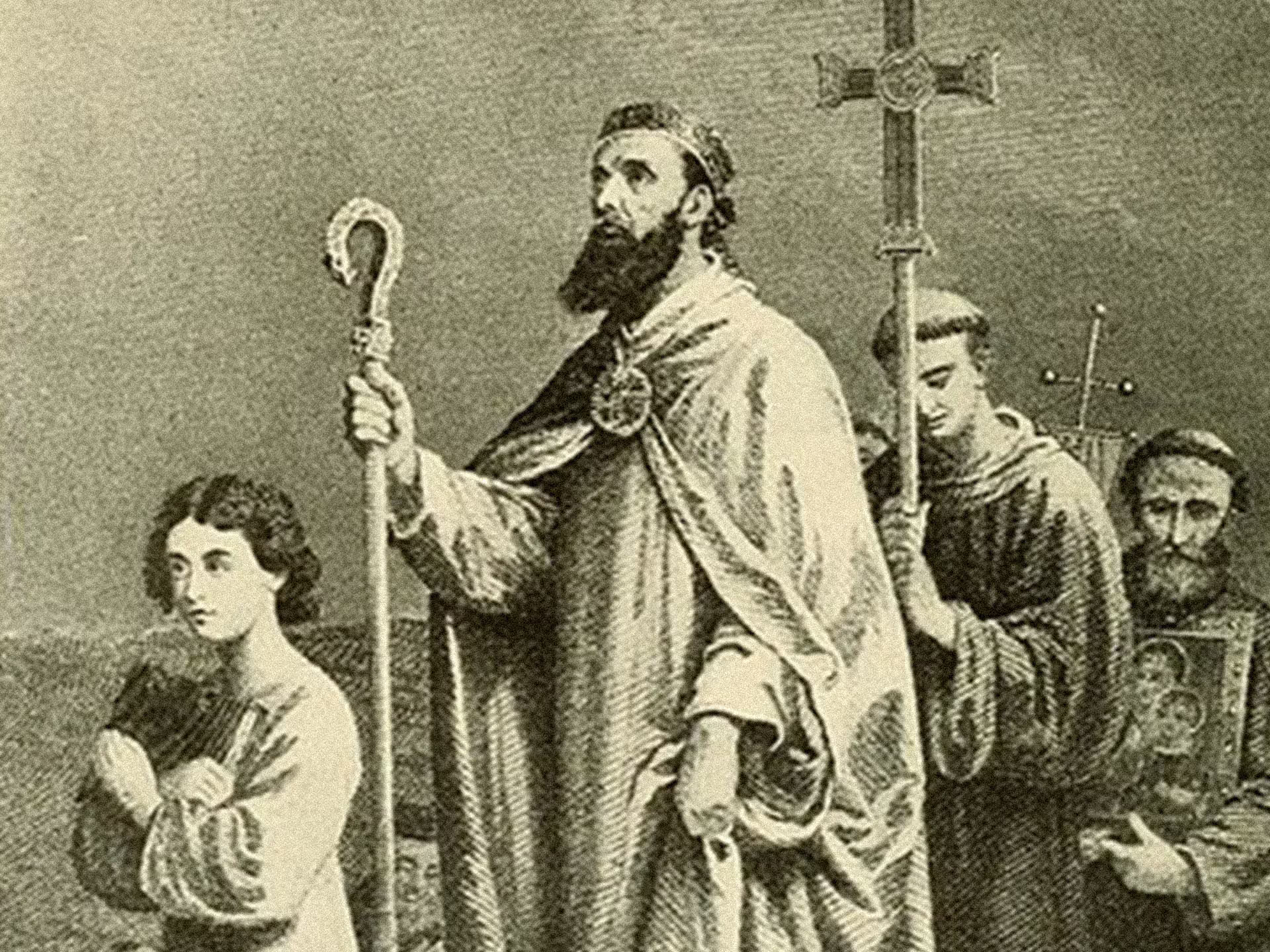
Patrick was not a green-clad, Irish, Roman Catholic saint. He was a missionary, one willing to lay down his life for the gospel.
Celtic Culture and Legends
There is, perhaps, more lore surrounding Patrick, the missionary who brought the good news of Christ to Ireland, than any other missionary in Christian history. In order to understand the real Patrick, we must first understand a little about pre-Patrick Ireland.
Ireland was a nation shaped by the polytheistic religion of the druids. They worshiped multiple gods and goddesses associated with natural elements. Sun, water, earth, etc. all had deities connected to them. They were also a hierarchical society, structured around priests, novices, bards, and seers. Each was deeply involved in pagan practice.
It’s worth debunking some legends and assumptions about Patrick too, like, for example, that he was Irish. Patrick came to Ireland as a missionary, but he was not, in fact, Irish. The real Patrick was abducted by the Irish and enslaved, escaped, and then later returned as a missionary.
Other legends include stories that Patrick used the shamrock to teach the Trinity, that he drove the snakes from Ireland, or that he jabbed his staff into the ground and it blossomed into a tree, converting many to Christianity. Although there may be profound truths or metaphors at the roots of these legends, not one is based in fact. Furthermore, the famous “Patrick’s Breastplate” slogan – “Christ be with me, Christ within me, Christ behind me, Christ before me, Christ to me, Christ beneath me, Christ above me” – cannot be attributed to Patrick with any measure of confidence. Finally, despite common usage, “Saint Patrick” was never canonized as a saint in the Roman Catholic Church.
The Real Patrick
So, if “Saint Patrick” wasn’t a saint, wasn’t Irish, and didn’t do the things he’s most well known for, who was he? From his few surviving letters and his Confessio, it seems that Patrick was more like the missionaries we recognize today than the legends would have it. He was a preacher. He used words, not miracles and signs and wonders.
Patrick was born around 385, and he died sometime between 461 and 464. We know that his family was well to do, but unlike many of his class in those times is that he doesn’t have the same level of education. He was raised in a Christian home. His father, Calpurnius, was a deacon, son of Potitus, a presbyter. We also know that he was from Bannavem Taburniae. Tradition has it that Bannavem Taburniae is in Scotland, Wales, England, or even France, but the exact location has never been found.
When he was around 16 years old Patrick was enslaved. We’re told that he herded goats, sheep, or swine (possibly added because of the parable of the prodigal son). Of this time, Patrick wrote that,
“the Lord opened to me the sense of my unbelief that I might at last remember my sins and be converted with all my heart to the Lord my God, who had regard for my lowest state and pitied my ignorance and youth.”
Eventually the newly converted Patrick was able to escape and return to his home by stowing away on a ship. But, perhaps surprisingly, in the time he was away from the Irish people, his heart for the Irish grew. One night he had a vision of man who delivered a letter, “The Voice of the Irish,” which begged him to return to Ireland.
Patrick resolved to return to Ireland, but he took time to pursue ministerial preparation and theological training. He spent 12 years studying the scriptures in a French monastery called the monastery of St. Germain. As he prepared to go, he said, “I am ready to be killed, betrayed into slavery or whatever may come my way for the sake of your name.”
Return to Ireland
Patrick returned to Ireland not knowing whether he would have success. He didn’t have modern demographic research, and very little knowledge of the Irish appetite for the gospel, but the Lord blessed his work:
“For I am greatly God’s debtor, who has granted me such grace that many people through me were reborn to God and afterward confirmed, and that clergy were ordained everywhere for them, for a people newly come to belief, whom the Lord took from the ends of the earth, as he once promised through the prophets… So that even before my death I should see a multitude of peoples born again in God.”
Despite lacking a corpus of the sermons of Patrick, we know he had success in his ministry as a pastor. Some attribute this to the king, because under Patrick’s ministry the magistrate put to death 800 druid priests who were unwilling to be converted. However, the growth of Celtic Christianity in the years following would suggest something more than political expedience.
Patrick is buried in Downpatrick in Northern Ireland. A cathedral was built on the site, said to be Patrick’s stone under which he’s buried.
Celtic Christianity
The Ireland of Patrick’s day had never been part of the Roman Empire, though its harbors were known to the Romans through trade. It was probably merchants who first brought Christianity to Ireland in the fourth century. In 431, Pope Celestine sent a man named Palladius from Gaul to the Christians in Ireland. Almost nothing is known about Palladius’s role in the spread of Christianity in Ireland. But it’s likely that some Irish already knew something of Christianity even before Patrick arrived.
After Patrick’s death, Celtic Christianity continued to flourish for well over 200 years without any involvement from Rome. It was a church in which Scripture was the primary source of authority, guiding the community’s faith and practice. Monasteries, pastors, and elders within the church were connected and there was discussion among them as to what should be going on within the church. They weren’t just developing different thoughts and ideas on their own. There was also an emphasis on personal religion, and there was a missionary zeal, a fervor to spread Christianity. This was a focus on what some would call “all of life Christianity,” their faith affecting their homes, their private lives, their communities, and the state. But this didn’t last forever.
There was, eventually, a romanizing of Celtic Christianity, at the Synod of Whitby in 664, born from a desire to align with Rome in order to strengthen ties to a broader Christianity. The shift would essentially destroy Celtic Christianity, replacing it with what was in Rome.
Patrick’s Legacy
The next time St. Patrick’s Day comes around, remember that Patrick was not a green-clad, Irish, Roman Catholic saint. He was a missionary, one willing to lay down his life for the gospel. One fully committed to the advancement of the gospel through the growth of the church – seeking worship from the voice of the gospel. Patrick was a man of grace.
As Patrick said so long ago, “I am greatly a debtor to God who has granted me such great grace that many people through me should be reborn to God.”
“I am ready to be killed, betrayed into slavery or whatever may come my way for the sake of your name.”
Additional Resources
Read an article debunking myths and telling of Patrick’s life.