Tag: prodigal son

  • Come As You Are

    A Father’s Day Invitation from Your Heavenly Father

    https://images.openai.com/static-rsc-4/VzO0YaXxqmdVJRd15aEUjYRZVje-ByS_4Y8goQcHU4ruCPYrhSN96mHhGw9bIr4ze66p1ORifB7OX0LYzI2L45OOiwKUps_D1N8cfTe5t5zJ06zXqv6n1RMTP79Glqcm-Dfxi8-sZpZUANUMip8iwCC64Iv-4knTRU3CMvNkVTGL6qCj7G_0283c6vVx6P4D?purpose=fullsize
    https://images.openai.com/static-rsc-4/f_o11uqVzJHxH27wgGA2SnyxT-ZLC9nZSpZ3UIirg7bAMfiMxBFgoA4xgk07VQQPmRf6CJaglD1KA3ctCFE5WYGWzlY0trdTTQZkF32myz154Sxdf0mMnMsXTu5boU1QmhMhVzeO2hmN3NAB5CkNC_R2ds7lDJDFVTPmHi-588QM1RXKwkm_g3ps64fr4afc?purpose=fullsize
    https://images.openai.com/static-rsc-4/XTtlY5EaWRUBzTQqlslFR_tSPHTFOhGCQI2k-Sz12Z_t-NI4j7Ef4HZUBRw9763Ud9iAJ5D79UlNNhvPEHx_sdRSV_IfwqqrGpohqi6FSi415RV4TSjCfOVi1vrUAdDdAjeU7_-UXLf-HO9G5h48B4onZC0PmCxHzTeqAAhkRwwOAF9OZXkTkNmUbxI7CuCU?purpose=fullsize

    Come As You Are

    On this Father’s Day in the United States, there is a Father who longs to see you just as you are.

    Not the polished version.

    Not the version that tries to impress others.

    Not the version hidden behind titles, accomplishments, or appearances.

    Just you.

    The real you.

    Your Heavenly Father is not asking for perfection. He is asking for your presence.

    Like the prodigal son in the Gospel, many of us have wandered. Some have wandered far from God. Others sit faithfully in church each week while carrying wounds, fears, regrets, and disappointments deep within their hearts.

    Yet the Father’s invitation remains the same:

    “Come home.”

    The Father Who Waits

    In the parable of the prodigal son, the father never stopped loving his child.

    He watched.

    He waited.

    He hoped.

    And when he saw his son returning from a distance, he did not condemn him. He did not lecture him. He did not shame him.

    Instead, he ran to him.

    He embraced him.

    He welcomed him home.

    That is how God feels about each one of us.

    Many people spend their lives searching for love, acceptance, and belonging. Yet our Heavenly Father has already prepared all of these things for us. His heart longs for us to receive the love He freely offers.

    Let God Love You

    Sometimes the hardest thing to do is simply accept that we are loved.

    We know our mistakes.

    We remember our failures.

    We see our weaknesses.

    But God sees something more.

    He sees the son He created.

    He sees the daughter He formed.

    He sees a beloved child made in His image.

    When we come before Him in humility, He lifts us up. When we surrender our burdens, He carries them. When we acknowledge our need for Him, He fills us with His grace.

    The Father does not merely tolerate you.

    He delights in you.

    The Feast Is Waiting

    The father in the Gospel did not merely welcome his son home.

    He prepared a feast.

    That feast symbolizes the joy of life with God and the fellowship of His family.

    At God’s table there is room for everyone.

    There is peace for the troubled.

    There is hope for the discouraged.

    There is healing for the wounded.

    There is joy for the weary.

    There is love beyond anything this world can offer.

    God desires that we share this feast with our brothers and sisters, encouraging one another and growing together in faith.

    Love Poured Out on the Cross

    The greatest proof of the Father’s love was revealed on Calvary.

    Jesus Christ stretched out His arms upon the Cross and poured out His life for us.

    Every drop of His Precious Blood proclaimed the same message:

    “You are loved.”

    The Cross is not a symbol of defeat.

    It is the greatest victory of love the world has ever known.

    God did not wait for us to become perfect before loving us.

    He loved us first.

    He loves us now.

    And He will love us forever.

    A Peace Beyond Understanding

    Today, your Heavenly Father invites you to stop running.

    Stop hiding.

    Stop pretending.

    Come as you are.

    Bring your hopes.

    Bring your fears.

    Bring your sins.

    Bring your wounds.

    Bring your entire heart.

    Allow Him to embrace you with His mercy and fill you with a peace beyond understanding.

    Surrender yourself to His loving care.

    Become the child of God He created you to be.

    For you were made for more than this world can offer.

    You were created for eternal life, eternal joy, and eternal communion with the Father who loves you beyond measure.

    And His invitation remains open today:

    Come home. Come as you are.

    “See what love the Father has bestowed on us that we may be called the children of God.” — 1 John 3:1

    Happy Father’s Day, and may God the Father bless you abundantly with His love, peace, and joy. 🙏

    and may you accept it and embrace it. Make Your Father in Heaven very happy as you come to and truly accept His Eternal, Pease, and Joy. Live with Passion. Live for God today. He is truly living for you.

    Thank you for reading this blog. Please share it with others.

    Rick Herring
    thmjmj@gmail.com
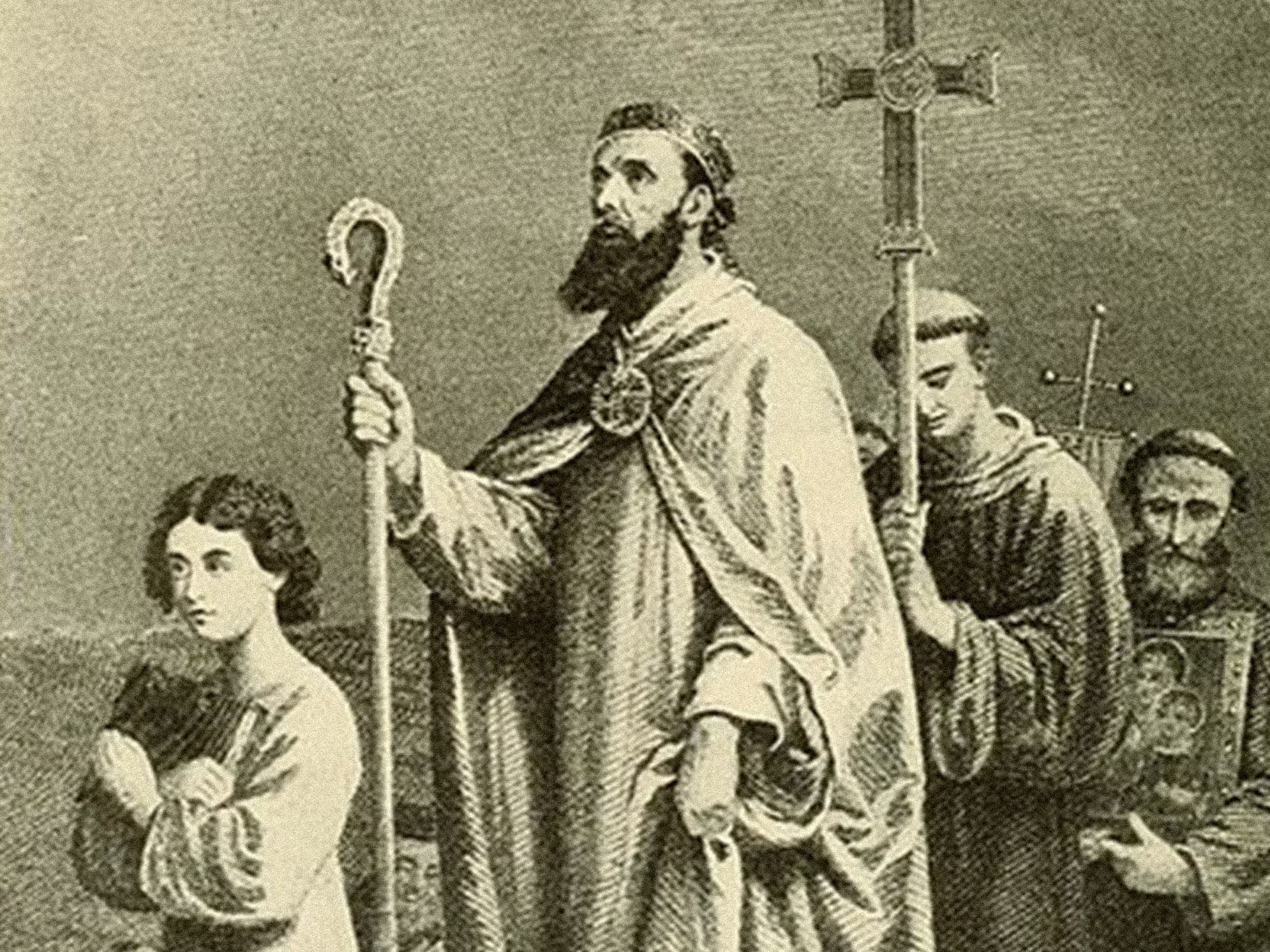
  • Saint Patrick


    Biography

    Patrick

    385-464

    Patrick was not a green-clad, Irish, Roman Catholic saint. He was a missionary, one willing to lay down his life for the gospel.

    Celtic Culture and Legends

    There is, perhaps, more lore surrounding Patrick, the missionary who brought the good news of Christ to Ireland, than any other missionary in Christian history. In order to understand the real Patrick, we must first understand a little about pre-Patrick Ireland. 

    Ireland was a nation shaped by the polytheistic religion of the druids. They worshiped multiple gods and goddesses associated with natural elements. Sun, water, earth, etc. all had deities connected to them. They were also a hierarchical society, structured around priests, novices, bards, and seers. Each was deeply involved in pagan practice.

    It’s worth debunking some legends and assumptions about Patrick too, like, for example, that he was Irish. Patrick came to Ireland as a missionary, but he was not, in fact, Irish. The real Patrick was abducted by the Irish and enslaved, escaped, and then later returned as a missionary. 

    Other legends include stories that Patrick used the shamrock to teach the Trinity, that he drove the snakes from Ireland, or that he jabbed his staff into the ground and it blossomed into a tree, converting many to Christianity. Although there may be profound truths or metaphors at the roots of these legends, not one is based in fact. Furthermore, the famous “Patrick’s Breastplate” slogan – “Christ be with me, Christ within me, Christ behind me, Christ before me, Christ to me, Christ beneath me, Christ above me” – cannot be attributed to Patrick with any measure of confidence. Finally, despite common usage, “Saint Patrick” was never canonized as a saint in the Roman Catholic Church. 

    The Real Patrick

    So, if “Saint Patrick” wasn’t a saint, wasn’t Irish, and didn’t do the things he’s most well known for, who was he? From his few surviving letters and his Confessio, it seems that Patrick was more like the missionaries we recognize today than the legends would have it. He was a preacher. He used words, not miracles and signs and wonders.

    Patrick was born around 385, and he died sometime between 461 and 464. We know that his family was well to do, but unlike many of his class in those times is that he doesn’t have the same level of education. He was raised in a Christian home. His father, Calpurnius, was a deacon, son of Potitus, a presbyter. We also know that he was from Bannavem Taburniae. Tradition has it that Bannavem Taburniae is in Scotland, Wales, England, or even France, but the exact location has never been found.

    When he was around 16 years old Patrick was enslaved. We’re told that he herded goats, sheep, or swine (possibly added because of the parable of the prodigal son). Of this time, Patrick wrote that, 

    “the Lord opened to me the sense of my unbelief that I might at last remember my sins and be converted with all my heart to the Lord my God, who had regard for my lowest state and pitied my ignorance and youth.” 

    Eventually the newly converted Patrick was able to escape and return to his home by stowing away on a ship. But, perhaps surprisingly, in the time he was away from the Irish people, his heart for the Irish grew. One night he had a vision of man who delivered a letter, “The Voice of the Irish,” which begged him to return to Ireland.  

    Patrick resolved to return to Ireland, but he took time to pursue ministerial preparation and theological training. He spent 12 years studying the scriptures in a French monastery called the monastery of St. Germain. As he prepared to go, he said, “I am ready to be killed, betrayed into slavery or whatever may come my way for the sake of your name.” 

    Return to Ireland

    Patrick returned to Ireland not knowing whether he would have success. He didn’t have modern demographic research, and very little knowledge of the Irish appetite for the gospel, but the Lord blessed his work:

    “For I am greatly God’s debtor, who has granted me such grace that many people through me were reborn to God and afterward confirmed, and that clergy were ordained everywhere for them, for a people newly come to belief, whom the Lord took from the ends of the earth, as he once promised through the prophets… So that even before my death I should see a multitude of peoples born again in God.”

    Despite lacking a corpus of the sermons of Patrick, we know he had success in his ministry as a pastor. Some attribute this to the king, because under Patrick’s ministry the magistrate put to death 800 druid priests who were unwilling to be converted. However, the growth of Celtic Christianity in the years following would suggest something more than political expedience.

    Patrick is buried in Downpatrick in Northern Ireland. A cathedral was built on the site, said to be Patrick’s stone under which he’s buried.

    Celtic Christianity

    The Ireland of Patrick’s day had never been part of the Roman Empire, though its harbors were known to the Romans through trade. It was probably merchants who first brought Christianity to Ireland in the fourth century. In 431, Pope Celestine sent a man named Palladius from Gaul to the Christians in Ireland. Almost nothing is known about Palladius’s role in the spread of Christianity in Ireland. But it’s likely that some Irish already knew something of Christianity even before Patrick arrived.​​ 

    After Patrick’s death, Celtic Christianity continued to flourish for well over 200 years without any involvement from Rome. It was a church in which Scripture was the primary source of authority, guiding the community’s faith and practice. Monasteries, pastors, and elders within the church were connected and there was discussion among them as to what should be going on within the church. They weren’t just developing different thoughts and ideas on their own. There was also an emphasis on personal religion, and there was a missionary zeal, a fervor to spread Christianity. This was a focus on what some would call “all of life Christianity,” their faith affecting their homes, their private lives, their communities, and the state. But this didn’t last forever.

    There was, eventually, a romanizing of Celtic Christianity, at the Synod of Whitby in 664, born from a desire to align with Rome in order to strengthen ties to a broader Christianity. The shift would essentially destroy Celtic Christianity, replacing it with what was in Rome.

    Patrick’s Legacy

    The next time St. Patrick’s Day comes around, remember that Patrick was not a green-clad, Irish, Roman Catholic saint. He was a missionary, one willing to lay down his life for the gospel. One fully committed to the advancement of the gospel through the growth of the church – seeking worship from the voice of the gospel. Patrick was a man of grace.

    As Patrick said so long ago, “I am greatly a debtor to God who has granted me such great grace that many people through me should be reborn to God.”

    “I am ready to be killed, betrayed into slavery or whatever may come my way for the sake of your name.” 

    Additional Resources

    • Read an article debunking myths and telling of Patrick’s life.
    • Read his Confessio.
    • Rick Herring
      thmjmj@gmail.com