“O Lord, my heart is not lifted up; my eyes are not raised too high…”
These words from Psalm 131 feel almost countercultural today.
We live in a world that rewards self-promotion. Social media tells us to build platforms. Culture tells us to “dream bigger,” “be louder,” “stand taller.” Yet this short psalm invites us into something radically different: humility.
The psalmist is not shrinking back in insecurity. He is not denying his worth. Instead, he is choosing a posture of trust. He is saying, “I don’t have to understand everything. I don’t have to control everything. I don’t have to elevate myself.”
There is deep freedom in that confession.
When our hearts are “lifted up” in pride, we are restless. When our eyes are “raised too high,” we compare, compete, and strain. Humility lowers the temperature of the soul. It releases us from the exhausting burden of self-importance.
Letting Go of What Is Too Great
“I do not occupy myself with things too great and too marvelous for me.”
How much of our anxiety comes from trying to manage what only God can handle?
We want to solve tomorrow’s problems today. We want to understand mysteries that were never meant for us to carry. We want control over outcomes that belong to the Lord alone.
The psalmist chooses restraint. He refuses to obsess over what is “too marvelous.” This is not ignorance — it is surrender. It is the recognition that some things are beyond us, and that is okay.
Faith does not require full understanding. It requires trust.
The Image of a Weaned Child
“But I have calmed and quieted my soul, like a weaned child with its mother; like a weaned child is my soul within me.”
This is one of the most tender images in all of Scripture.
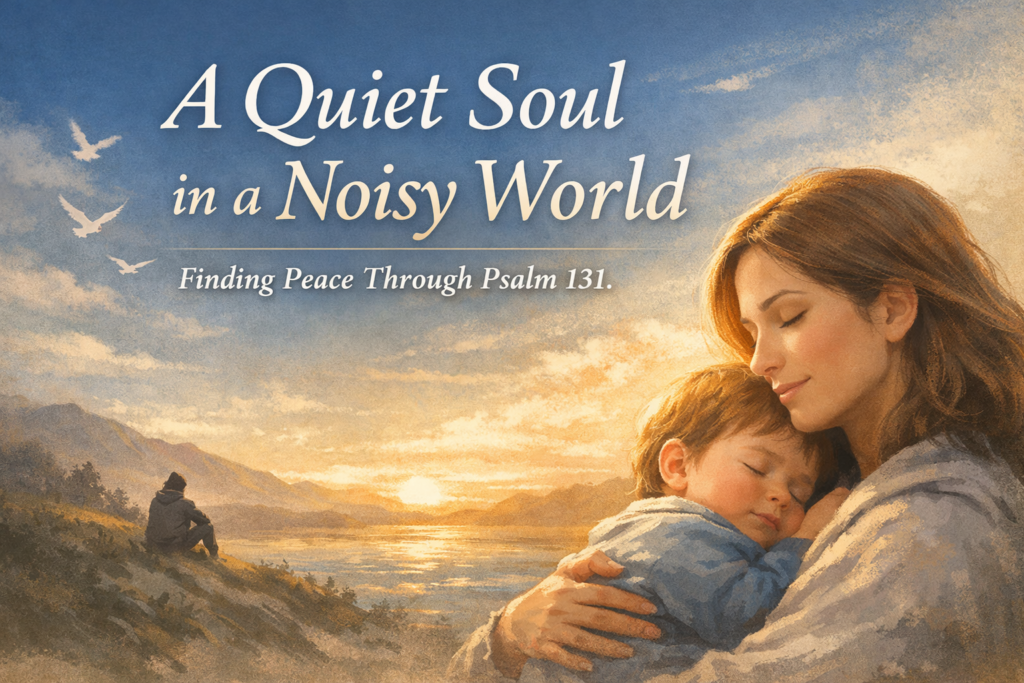
A nursing infant cries from need. But a weaned child rests simply for the joy of being near the mother. The hunger has subsided. The striving has ceased. The relationship remains.
The psalmist describes a soul that is no longer frantic for answers, success, recognition, or immediate provision. Instead, it is content just to be with God.
Not demanding. Not bargaining. Not striving.
Just resting.
That is spiritual maturity.
It is the difference between coming to God only for what He gives and coming to Him simply because He is God.
Calming the Soul
Notice the phrasing: “I have calmed and quieted my soul.”
This quietness did not happen by accident. It was intentional.
In our time, quiet is rare. Notifications buzz. News cycles spin. Worries accumulate. But the psalmist shows us that inner stillness is possible — even in chaos.
Calming the soul is an act of trust. It is choosing to believe that God is at work even when we cannot see it. It is placing our restless thoughts into His hands and saying, “You are enough.”
For those building businesses, raising families, writing books, serving churches, or simply trying to make it through another week, this psalm offers a powerful reminder: you do not have to carry the universe on your shoulders.
God already does.Hope That Extends Beyond Today
“O Israel, hope in the Lord from this time forth and forevermore.”
The psalm ends not with self-focus, but with invitation.
Hope is not wishful thinking. It is confident expectation rooted in the character of God. The psalmist calls the entire community to anchor their future in the Lord — not just for today’s crisis, but forever.
Hope grows best in humble soil. When we release pride, surrender control, and quiet our souls, we create space for hope to flourish.
Living Psalm 131 Today
Psalm 131 is only three verses long, yet it speaks volumes:
Choose humility over self-exaltation.
Release what is beyond your control.
Quiet your soul in God’s presence.
Place your hope in Him — today and always.
A Reflection on Psalm 131
Humility in a World That Demands Attention
“O Lord, my heart is not lifted up; my eyes are not raised too high…”
These words from Psalm 131 feel almost countercultural today.
We live in a world that rewards self-promotion. Social media tells us to build platforms. Culture tells us to “dream bigger,” “be louder,” “stand taller.” Yet this short psalm invites us into something radically different: humility.
The psalmist is not shrinking back in insecurity. He is not denying his worth. Instead, he is choosing a posture of trust. He is saying, “I don’t have to understand everything. I don’t have to control everything. I don’t have to elevate myself.”
There is deep freedom in that confession.
When our hearts are “lifted up” in pride, we are restless. When our eyes are “raised too high,” we compare, compete, and strain. Humility lowers the temperature of the soul. It releases us from the exhausting burden of self-importance.
Letting Go of What Is Too Great
“I do not occupy myself with things too great and too marvelous for me.”
How much of our anxiety comes from trying to manage what only God can handle?
We want to solve tomorrow’s problems today. We want to understand mysteries that were never meant for us to carry. We want control over outcomes that belong to the Lord alone.
The psalmist chooses restraint. He refuses to obsess over what is “too marvelous.” This is not ignorance—it is surrender. It is the recognition that some things are beyond us, and that is okay.
Faith does not require full understanding. It requires trust.
The Image of a Weaned Child
“But I have calmed and quieted my soul, like a weaned child with its mother; like a weaned child is my soul within me.”
This is one of the most tender images in all of Scripture.
A nursing infant cries from need. But a weaned child rests simply for the joy of being near the mother. The hunger has subsided. The striving has ceased. The relationship remains.
The psalmist describes a soul that is no longer frantic for answers, success, recognition, or immediate provision. Instead, it is content just to be with God.
Not demanding. Not bargaining. Not striving.
Just resting.
That is spiritual maturity.
It is the difference between coming to God only for what He gives and coming to Him simply because He is God.
Calming the Soul
Notice the phrasing: “I have calmedNotice the phrasing: “I have calmed and quieted my soul.”
This quietness did not happen by accident. It was intentional.
In our time, quiet is rare. Notifications buzz. News cycles spin. Worries accumulate. But the psalmist shows us that inner stillness is possible—even in chaos.
Calming the soul is an act of trust. It is choosing to believe that God is at work even when we cannot see it. It is placing our restless thoughts into His hands and saying, “You are enough.”
For those building businesses, raising families, writing books, serving churches, or simply trying to make it through another week, this psalm offers a powerful reminder: you do not have to carry the universe on your shoulders.
God already does.
Hope That Extends Beyond Today
“O Israel, hope in the Lord from this time forth and forevermore.”
The psalm ends not with self-focus, but with invitation.
Hope is not wishful thinking. It is confident expectation rooted in the character of God. The psalmist calls the entire community to anchor their future in the Lord—not just for today’s crisis, but forever.
Hope grows best in humble soil. When we release pride, surrender control, and quiet our souls, we create space for hope to flourish.
Living Psalm 131 Today
Psalm 131 is only three verses long, yet it speaks volumes:
Choose humility over self-exaltation.
Release what is beyond your control.
Quiet your soul in God’s presence.
Place your hope in Him—today and always.
In a world obsessed with noise and achievement, this psalm whispers a better way.
Be small in your own eyes. Be still in your spirit. Be secure in your God.
And like a weaned child resting peacefully, let your soul find its calm in Him.
a world obsessed with noise and achievement, this psalm whispers a better way.
Be small in your own eyes. Be still in your spirit. Be secure in your God.
And like a weaned child resting peacefully, let your soul find its calm in Him.
If you liked this article, please share your feedback and follow me for more stories.
Rick Herring thmjmj@gmail.com
P.S. There are many budget recipes on this Website. Many could be comfort food. Click on blogs in the upper left hand corner access the recipes and much more.