To build Community we must share. We must care for those around us. To be a blessing we must truly be a blessing.
You are my community. We truly have a community of love and sharing, joy and peace. The time has come to add a sustainable income source so we can help those that have no income. Those that are struggling. Those that need a helping hand. a hand up.
This is the community we are building. A community where we share, care, lift up, become one with God our Father. To be fill with and guided by the Holy Spirit.
“The Lord hears the cry of the poor.” Psalm 34: 6 Together we can build a community that has the resources to reach, while building our resources, our email list, our income.
These are just a few of the short Bible verse videos I ha ve posted on YouTube and other social media. Many are getting over 100 views their first day.
Sunday – I was able to attend Mass at Saint Luke Catholic Church in Irving, Texas. The Altar was very beautifully decorated. In the area around the Altar were flowers and the tomb with the Resurrected Jesus standing in front of the tomb.
Here at WFV there was a Church Service. We received a box lunch for dinner so the staff could leave by 2:30 and be with their families.
Monday – Doctor’s Appointments all day. A midday Church Service. A supper outing at Grimaldis.
Tuesday – Errands at 9 AM and 1 PM. Birthday Card Signing for those having birthdays in May.
Wednesday – Doctor’s Appointments all day. Bible study. A lunch outing to Gimaldes. Craft Meeting. Classy Classical, Bingo, and an evening Church Service.
Thursday – Birthday Social. Residents Council Meeting.
Friday – Almas Cafe Outing. A trip to Dollar.Doctor’s Appointments, Tree. Brownie Sundaes. Monthly Planning Meeting. New Residents Orientation and Movie Night.
Saturday – Hope Meeting.
Starting Wednesday, I was quarantined, so I am only telling what was scheduled. One of my close neighbors made sure we received the goodies from the Social events. What a family we have here at WFV.
As for myself I started publishing short Bible Verse videos, which received quite a few views. I post them on YouTube, Facebook, Tiktok, linkedin, and Instagram. I also post on YouTube where, with some searching I can see how many views they get. Many are getting over 100 views. One received over 200 views. The count in views was over 400 for the first 48 hours. Hopefully a good start
Even so it was a packed week at West Fork Village. A Place Where Seniors Thrive.
To learn more about WFV in Irving, Texas, for you or a loved one, call 972-721-1500.
If you liked this blog, please share your feedback. Share with others and come back for more stories.
OUR LORD’S PROMISES ATTACHED TO THE PRAYING OF THE CHAPLET OF DIVINE MERCY AS REVEALED TO ST. FAUSTINA KOWALSKA
“I promise that the soul that will venerate this image (of Divine Mercy) will not perish. I also promise victory over (its) enemies already here on earth, especially at the hour of death. I Myself will defend it as My own glory.” (Diary, 48)
“The souls that say this chaplet will be embraced by My mercy during their lifetime and especially at the hour of their death.” (Diary, 754)
“When hardened sinners say it, I will fill their souls with peace, and the hour of their death will be a happy one.” (Diary, 1541)
“When they say this chaplet in the presence of the dying, I will stand between My Father and the dying person, not as a just Judge but as a merciful Savior.” (Diary, 1541)
“Whoever will recite it will receive great mercy at the hour of death.” (Diary, 687)
“Priests will recommend it to sinners as their last hope of salvation. Even if there were a sinner most hardened, if he were to recite this chaplet only once, he would receive grace from My infinite mercy…I desire to grant unimaginable graces to those souls who trust in My mercy.” (Diary, 687)
“To priests who proclaim and extol My mercy, I will give wondrous power; I will anoint their words and touch the hearts of those to whom they will speak.” (Diary, 1521)
“The prayer most pleasing to Me is prayer for the conversion for sinners. Know, my daughter, that this prayer is always heard and answered.” (Diary, 1397)
“At three o’clock, implore My mercy, especially for sinners; and, if only for a brief moment, immerse yourself in My Passion, particularly in My abandonment at the moment of agony…I will refuse nothing to the soul that makes a request of Me in virtue of My Passion.” (Diary, 1320; also, cf. Diary, 1572)
“Souls who spread the honor of My mercy…at the hour of death I will not be a Judge for them, but the Merciful Savior.” (Diary, 1075)
“The two rays denote Blood and Water…These two rays issued from the very depths of My tender mercy when My agonized Heart was opened by a lance on the Cross. These rays shield souls from the wrath of My Father…I desire that the first Sunday after Easter be the Feast of Mercy…whoever approaches the Fount of Life on this day will be granted complete remission of sins and punishment. Mankind will not have peace until it turns with trust to My mercy.” (Diary, 299-300)
“I desire that the Feast of Mercy…be solemnly celebrated on the first Sunday after Easter…The soul that will go to Confession and receive Holy Communion (in a state of grace on this day) shall obtain complete forgiveness of sins and punishment.” (Diary, 699)
“Through this chaplet you will obtain everything, if what you ask for is compatible with My will.” (Diary, 1731)
“My mercy is greater than your sins and those of the entire world.” (Diary, 1485)
Fr. Wade L. J. Menezes, CPM is a member of the Fathers of Mercy, a missionary preaching Religious Congregation based in Auburn, Kentucky. Ordained a priest during the Great Jubilee Year 2000, he received his Bachelor of Arts Degree in Catholic Thought from the Oratory of St. Philip Neri in Toronto, Canada and his dual Master of Arts and Master of Divinity Degrees in Theology from Holy Apostles Seminary in Cromwell, Connecticut. His secular college degrees are in journalism and communications. View all posts by Fr. Wade Menezes →
The Chaplet of Divine Mercy, revealed to Saint Faustina Kowalska by Jesus Christ, is not only a prayer—it is a channel of extraordinary promises.
Recorded in Faustina’s diary, Divine Mercy in My Soul, these promises were spoken by Jesus Himself, offering hope and grace to a world in need.
This chaplet is rooted in one simple truth:
God’s mercy is infinite—and He desires to pour it out upon us.
✨ The Promise of Mercy at the Hour of Death
One of the most powerful promises associated with the chaplet concerns the moment we all must face—the hour of death.
Jesus said:
“Whoever will recite it will receive great mercy at the hour of death.”
Even more astonishing:
“When they say this chaplet in the presence of the dying, I will stand between My Father and the dying person… as the merciful Savior.”
This promise brings profound comfort. Whether prayed for oneself or for another, the chaplet becomes a shield of mercy at life’s final moment.
💖 The Promise for Sinners
The Chaplet of Divine Mercy is especially offered for sinners—indeed, for all of us.
Jesus declared:
“The greater the sinner, the greater the right he has to My mercy.”
And further:
“Though your sins be as scarlet… they will become white as snow.”
No soul is beyond hope. The chaplet is a lifeline for those who feel lost, burdened, or far from God.
🌍 The Promise for the Whole World
Unlike many personal devotions, the Chaplet extends beyond the individual—it embraces all humanity.
Each time we pray:
“Have mercy on us and on the whole world,”
we intercede for everyone—family, strangers, even those we may never meet.
Jesus promised that through this prayer:
Souls will receive unimaginable graces
God’s mercy will be poured out upon the world
Hearts will be transformed
🕊️ The Promise of Peace
In a restless and anxious world, the Chaplet brings interior peace.
Those who pray it regularly often experience:
A deeper trust in God
Calm in times of suffering
Strength during trials
A sense of God’s presence
Jesus encouraged persistent prayer, reminding us that His mercy is always available—especially when we turn to Him with trust.
🙏 The Hour of Great Mercy
Jesus also emphasized a special time: 3:00 PM, the Hour of Mercy—the moment of His death on the Cross.
He said:
“At three o’clock, implore My mercy… In this hour, I will refuse nothing to the soul that makes a request of Me.”
Praying the chaplet at this hour carries special significance, uniting us spiritually with Christ’s sacrifice.
✝️ Final Reflection
The promises attached to the Chaplet of Divine Mercy are not just words—they are an invitation.
An invitation to trust. An invitation to return. An invitation to receive a love that never fails.
In a world searching for hope, this prayer stands as a quiet but powerful assurance:
Mercy is always greater than sin.
📣 Call to Action
Have you experienced peace or grace through the Chaplet of Divine Mercy? Share your story or prayer intentions in the comments below. Let us pray for one another 🙏
Click Here for Miracles attached to The Divine Mercy Chaplet and much more
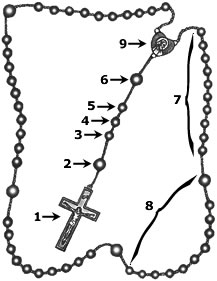
The Chaplet of Divine Mercy is recited using ordinary Rosary beads of five decades. The Chaplet is preceded by two opening prayers from the Diary of Saint Maria Faustina Kowalska and followed by a closing prayer.
In the name of the Father, and of the Son, and of the Holy Spirit. Amen.
2. Optional Opening Prayers
St. Faustina’s Prayer for Sinners O Jesus, eternal Truth, our Life, I call upon You and I beg Your mercy for poor sinners. O sweetest Heart of my Lord, full of pity and unfathomable mercy, I plead with You for poor sinners. O Most Sacred Heart, Fount of Mercy from which gush forth rays of inconceivable graces upon the entire human race, I beg of You light for poor sinners. O Jesus, be mindful of Your own bitter Passion and do not permit the loss of souls redeemed at so dear a price of Your most precious Blood. O Jesus, when I consider the great price of Your Blood, I rejoice at its immensity, for one drop alone would have been enough for the salvation of all sinners. Although sin is an abyss of wickedness and ingratitude, the price paid for us can never be equalled. Therefore, let every soul trust in the Passion of the Lord, and place its hope in His mercy. God will not deny His mercy to anyone. Heaven and earth may change, but God’s mercy will never be exhausted. Oh, what immense joy burns in my heart when I contemplate Your incomprehensible goodness, O Jesus! I desire to bring all sinners to Your feet that they may glorify Your mercy throughout endless ages (Diary of Saint Maria Faustina Kowalska, 72).
You expired, Jesus, but the source of life gushed forth for souls, and the ocean of mercy opened up for the whole world. O Fount of Life, unfathomable Divine Mercy, envelop the whole world and empty Yourself out upon us.
(Repeat three times) O Blood and Water, which gushed forth from the Heart of Jesus as a fount of mercy for us, I trust in You!
3. Our Father
Our Father, Who art in Heaven, hallowed be Thy name; Thy kingdom come; Thy will be done on earth as it is in Heaven. Give us this day our daily bread; and forgive us our trespasses, as we forgive those who trespass against us; and lead us not into temptation, but deliver us from evil, Amen.
4. Hail Mary
Hail Mary, full of grace. The Lord is with thee. Blessed art thou amongst women, and blessed is the fruit of thy womb, Jesus. Holy Mary, Mother of God, pray for us sinners, now and at the hour of our death, Amen.
5. The Apostles’ Creed
I believe in God, the Father almighty, Creator of Heaven and earth, and in Jesus Christ, His only Son, our Lord, who was conceived by the Holy Spirit, born of the Virgin Mary, suffered under Pontius Pilate, was crucified, died and was buried; He descended into hell; on the third day He rose again from the dead; He ascended into Heaven, and is seated at the right hand of God the Father almighty; from there He will come to judge the living and the dead. I believe in the Holy Spirit, the holy Catholic Church, the Communion of Saints, the forgiveness of sins, the Resurrection of the body, and life everlasting. Amen.
6. The Eternal Father
Eternal Father, I offer You the Body and Blood, Soul and Divinity of Your Dearly Beloved Son, Our Lord, Jesus Christ, in atonement for our sins and those of the whole world.
7. On the 10 Small Beads of Each Decade
For the sake of His sorrowful Passion, have mercy on us and on the whole world.
8. Repeat for the remaining decades
Saying the “Eternal Father” (6) on the “Our Father” bead and then 10 “For the sake of His sorrowful Passion” (7) on the following “Hail Mary” beads.
9. Conclude with Holy God (Repeat three times)
Holy God, Holy Mighty One, Holy Immortal One, have mercy on us and on the whole world.
10. Optional Closing Prayers
Eternal God, in Whom mercy is endless and the treasury of compassion — inexhaustible, look kindly upon us and increase Your mercy in us, that in difficult moments we might not despair nor become despondent, but with great confidence submit ourselves to Your holy will, which is Love and Mercy itself.
O Greatly Merciful God, Infinite Goodness, today all mankind calls out from the abyss of its misery to Your mercy — to Your compassion, O God; and it is with its mighty voice of misery that it cries out. Gracious God, do not reject the prayer of this earth’s exiles! O Lord, Goodness beyond our understanding, Who are acquainted with our misery through and through, and know that by our own power we cannot ascend to You, we implore You: anticipate us with Your grace and keep on increasing Your mercy in us, that we may faithfully do Your holy will all through our life and at death’s hour. Let the omnipotence of Your mercy shield us from the darts of our salvation’s enemies, that we may with confidence, as Your children, await Your [Son’s] final coming — that day known to You alone. And we expect to obtain everything promised us by Jesus in spite of all our wretchedness. For Jesus is our Hope: through His merciful Heart, as through an open gate, we pass through to Heaven (Diary, 1570).
“The prayer that flowed directly from the Heart of Christ”
🌿 A Revelation in Troubled Times
In the early 20th century, as the world trembled on the brink of war and moral uncertainty, a humble Polish nun named Saint Faustina Kowalska received extraordinary revelations that would echo across the globe.
Born in 1905, Faustina entered the Congregation of the Sisters of Our Lady of Mercy. She lived a quiet, hidden life—but her soul was chosen for a profound mission. Beginning in 1931, she began to receive visions of Jesus Christ, who appeared to her as the Divine Mercy.
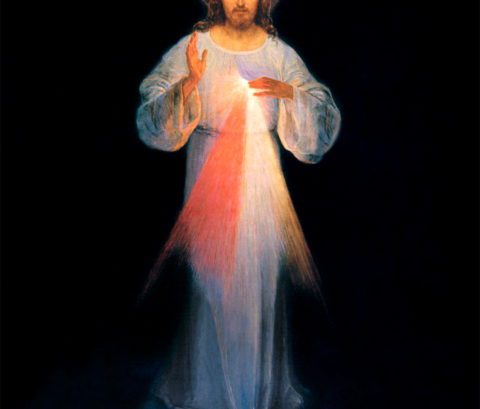
In one of these visions, Jesus asked that an image be painted with the words: “Jesus, I trust in You.”
From His heart flowed two rays—one pale, one red—symbolizing blood and water, the fountain of mercy for all humanity.
✨ The Chaplet: A Prayer Given by Jesus
On September 13, 1935, Faustina recorded in her diary a powerful new prayer—given directly by Jesus Himself. This would become known as the Chaplet of Divine Mercy.
Unlike traditional prayers developed over centuries, this chaplet is unique. According to Faustina’s writings, the words were dictated by Christ:
“Say unceasingly the chaplet that I have taught you… Whoever will recite it will receive great mercy at the hour of death.”
The prayer is prayed using ordinary rosary beads, but its words are striking:
“Eternal Father, I offer You the Body and Blood, Soul and Divinity…”
“For the sake of His sorrowful Passion, have mercy on us and on the whole world.”
Many faithful believe this may be among the only prayers ever given word-for-word by Jesus for mankind to use—making it a deeply intimate connection between Heaven and Earth.
🌍 Spreading the Message to the World
Faustina’s diary, later published as “Divine Mercy in My Soul,” became the foundation of the devotion. However, the message did not spread easily at first. There were misunderstandings and even temporary restrictions placed on the devotion.
But God’s timing is perfect.
A fellow Pole, Pope John Paul II, played a crucial role in bringing the message to the world. Having lived through the horrors of World War II, he deeply understood the need for Divine Mercy.
In the year 2000, he canonized Faustina and established Divine Mercy Sunday—to be celebrated on the Sunday after Easter.
Today, the Chaplet is prayed around the world, especially at 3:00 PM—the Hour of Mercy, the time of Christ’s death on the Cross.
💖 Why the Chaplet Matters Today
In a world still marked by suffering, division, and uncertainty, the Chaplet of Divine Mercy offers something timeless:
Hope for sinners
Comfort for the dying
Peace for troubled hearts
A reminder that God’s mercy is greater than any sin
Jesus promised Faustina:
“The greater the sinner, the greater the right he has to My mercy.”
This message is not one of judgment—but of invitation.
🙏 A Prayer for Our Time
The Chaplet of Divine Mercy is simple. It can be prayed anywhere—alone, with family, or for the whole world.
It is a prayer of offering, of trust, and of surrender.
Perhaps that is what makes it so powerful: not just that it was given by Christ… but that it leads us back to His Heart.
✝️ Final Reflection
If it is true that the Chaplet of Divine Mercy is among the only prayers given directly by Jesus in such a complete form, then it is a gift beyond measure—a divine whisper to humanity:
“Trust Me. Come to Me. Receive My mercy.”
And in praying it, we do something beautiful—we echo back to God the very words He gave us.
Click Here dor the way to pray The Chaplet of Divine Mercy.
In a world constantly chasing happiness through success, possessions, and fleeting pleasures, many find themselves still searching—still unsatisfied. Yet, the message at the heart of Christianity offers a radically different path: true and lasting joy is found in becoming more like Jesus Christ.
This idea may sound simple, even familiar. But its depth is life-changing. The more our thoughts, actions, and hearts align with Christ, the more we experience a profound, unshakable happiness that the world cannot give—or take away.
What Does It Mean to Become Like Christ?
Becoming like Christ doesn’t mean perfection—it means transformation. It is a daily process of growing in qualities that Jesus embodied:
Love – showing genuine care for others, even when it’s difficult
Compassion – reaching out to those in need
Humility – putting others before ourselves
Forgiveness – letting go of bitterness and extending grace
Faith – trusting God even when life is uncertain
These traits are not just moral ideals; they are the building blocks of a joyful life.
Why Christlike Living Brings Happiness
1. It Aligns Us with Our True Purpose
We are created with a spiritual purpose. When we live in harmony with Christ’s teachings, we step into that purpose—and purpose brings deep satisfaction.
2. It Frees Us from Destructive Emotions
Anger, envy, pride, and resentment weigh heavily on the soul. Christlike attributes—especially forgiveness and humility—release us from these burdens, making room for peace.
3. It Strengthens Relationships
Love and compassion transform how we interact with others. As we become more Christlike, our relationships become healthier, deeper, and more meaningful.
4. It Brings Inner Peace
Even in trials, those who follow Christ often experience a quiet confidence and calm. This peace is not dependent on circumstances—it is rooted in faith.
The Journey, Not Perfection
It’s important to remember: becoming like Christ is a journey, not a destination achieved overnight. There will be setbacks, doubts, and struggles. But every small step—every act of kindness, every moment of patience—moves us closer.
God does not expect perfection; He invites progress.
How to Grow Closer to Christ Daily
Here are simple, practical ways to grow:
Pray daily – Speak honestly with God and listen in stillness
Study scripture – Learn from Christ’s words and example
Serve others – Look for opportunities to help, even in small ways
Reflect regularly – Ask yourself how you can improve and grow
Practice gratitude – Recognize blessings and cultivate joy
These habits gradually shape the heart and bring us closer to Christ’s character.
A Joy That Lasts
Happiness that depends on circumstances is temporary. But the joy that comes from becoming more like Christ is enduring. It grows deeper over time, rooted in love, faith, and eternal perspective.
As we strive to follow His example, we don’t just become better people—we become happier people.happiness,
And in that transformation, we discover a truth both simple and profound:
The closer we come to Christ, the closer we come to true joy.
Thank you for reading this blog. Please share with others.





 1. Make the Sign of the Cross