Tag: kindness

  • The Good Newsletter

    Issue #1 – Welcome to a New Beginning

    Welcome to The Good News Newsletter!

    Thank you for joining us for the very first issue of The Good News Newsletter.

    In a world where headlines often focus on conflict, division, and discouragement, we believe there is still plenty of good news worth sharing. Every day, ordinary people perform acts of kindness, communities come together to help one another, and God continues to work quietly in the hearts of His people.

    This newsletter was created to shine a light on that good news.

    Our goal is simple: to provide a weekly dose of hope, faith, encouragement, and inspiration.

    Whether you are facing challenges, celebrating blessings, or simply looking for a positive perspective, we hope these messages help strengthen your faith and brighten your day.


    A MESSAGE OF HOPE

    Life is not always easy.

    We all experience setbacks, disappointments, health concerns, financial struggles, and moments of uncertainty. Yet throughout history, people of faith have discovered that difficult seasons often become the very moments that shape us into stronger, wiser, and more compassionate individuals.

    As Scripture reminds us:

    “And we know that all things work together for good for those who love God.” – Romans 8:28

    God does not promise a life free from difficulties. He promises that He will walk with us through them.

    No matter what you may be facing today, remember that your story is still being written. The chapter you are living now is not the end of the book.


    GOOD NEWS IN OUR COMMUNITIES

    Every day there are people making a difference.

    Volunteers serve meals to the hungry.

    Neighbors help neighbors.

    Churches provide support for families in need.

    Small businesses create opportunities and jobs.

    Healthcare workers care for the sick.

    Teachers inspire future generations.

    These acts may never make national headlines, but they are changing lives one person at a time.

    Good news is happening all around us if we take the time to look for it.


    FAITH CORNER

    One of the greatest truths of Christianity is that God loves each of us personally.

    The Feast of Corpus Christi reminds us that Christ continues to give Himself completely to His people.

    Christianity is not simply a set of beliefs or rules. At its heart, it is a love story—a loving God reaching out to His children and inviting them into a deeper relationship with Him.

    When life becomes difficult, remember that you are never alone.

    God knows your struggles, your hopes, your fears, and your dreams.

    And He walks beside you every step of the journey.


    THIS WEEK’S CHALLENGE

    Perform one unexpected act of kindness this week.

    Call someone who may be lonely.

    Send an encouraging message.

    Offer a prayer for someone in need.

    Help a neighbor.

    Volunteer your time.

    You may never know how much that small act means to another person.

    Kindness has a way of multiplying far beyond what we can see.


    LOOKING AHEAD

    Future editions of The Good News Newsletter will include:

    • Inspiring faith-based articles

    • Stories of hope and perseverance

    • Community highlights

    • Encouraging reflections

    • Practical ways to strengthen faith and serve others

    • Special resources and recommendations

    We are excited to share this journey with you.


    FINAL THOUGHT

    Never underestimate the power of hope.

    A kind word can change a day.

    A prayer can change a life.

    A faithful heart can change a community.

    Together we can help spread the Good News—one person, one family, and one community at a time.

    May God bless you and your loved ones.

    Rick Herring

    The Good News Newsletter

    “Creating Opportunities, Strengthening Communities, Changing Lives.”

    P.S. If you enjoy this newsletter, please share it with a friend and invite them to subscribe. Together we can spread a little more hope in the world.

  • A Different Kind of Virus Is Spreading — And It’s Built on Kindness

    What if the next thing to go viral actually helped people?

    The “Kindness Virus” is creating buzz online by combining generosity, community, and an income opportunity into one simple concept. For a one-time $150 entry, participants can begin sharing the movement and earn $100 for every person they refer who joins.

    The idea is straightforward:

    • Join the Kindness Virus community
    • Share it with others
    • Earn rewards when people you refer participate

    In fact, referring just two people puts you into profit.

    Supporters say the program is designed to encourage people to spread positivity while creating an opportunity to earn along the way. Whether you’re curious about the concept, looking for a side-income idea, or simply interested in community-driven projects, the Kindness Virus is getting attention fast.

    Want to learn more?

    Comment “VIRUS” or visit:
    Kindness Virus

    There’s a “kindness virus” spreading.

    It’s $150 to catch it.
    People are earning $100 per person they “infect.”

    The math is simple. Refer 2 people and you’re already in profit.

    Comment “VIRUS” to learn more Click Here.

    Thank you for reading this article. Please share with others,

    Rick
    thmjmj@gmail.com

  • The Kindness Economy

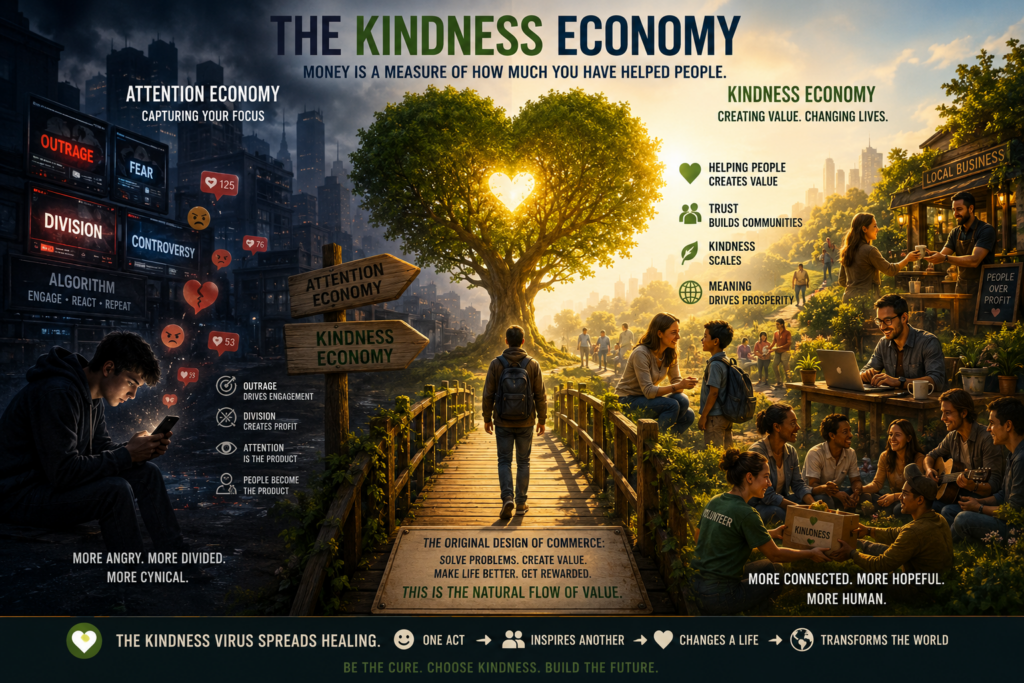
    We live in what economists and cultural critics call the Attention Economy — a system in which the most valuable resource is not oil, not gold, not even money, but human attention. Every notification, every headline, every scrolling feed is competing for a single scarce commodity: our focus.

    The largest companies in the world have built trillion-dollar empires on this principle. Social media platforms, streaming services, advertisers, and news outlets all profit by keeping us engaged for as long as possible. But there is a problem built into the system: outrage captures attention faster than peace. Fear spreads more quickly than hope. Anger generates more clicks than kindness.

    And so the digital world has slowly trained itself to reward negativity.

    The result is all around us. People are exhausted. Communities are fragmented. Public discourse often feels less like a conversation and more like a battlefield. The algorithms do not necessarily ask what is true, beautiful, or healing. They ask what will keep people reacting.

    But at the edges of this system, something extraordinary is beginning to emerge.

    A growing number of people are discovering another way to create value — and another way to earn a living. They are building businesses, communities, and movements not around outrage, but around encouragement, service, creativity, and compassion. They are participating in what might be called the Kindness Economy.

    The Kindness Economy begins with a radical but deeply human idea: money is, at its best, a measure of how much you have helped people.

    In its purest form, money is not merely compensation for suffering through work you hate. It is not simply a scoreboard for competition. It is the applause that society gives you for making someone’s life better.

    When you solve a problem, people reward you.

    When you create beauty, people support you.

    When you make others feel seen, heard, valued, and less alone, they remember you.

    This is not idealism. It is the original foundation of commerce itself.

    A farmer grows food that feeds a village. A carpenter builds homes that shelter families. A teacher shares wisdom that changes a child’s future. In every healthy economy, value flows toward those who improve life for others. The Kindness Economy simply restores that principle in a world that has become distracted by spectacle and division.

    What makes this moment unique is that technology — the very thing that intensified the Attention Economy — also makes the Kindness Economy possible on a global scale.

    Today, one person with sincerity and a smartphone can encourage millions. A small business can thrive by genuinely serving its customers instead of manipulating them. Independent creators can build loyal communities by teaching, uplifting, and inspiring. People no longer need permission from giant institutions to spread goodness. They can do it directly.

    And remarkably, kindness scales.

    A harsh comment may travel fast, but encouragement travels deep. Cynicism may dominate headlines, but hope changes lives. Every act of generosity creates ripples that move outward through families, friendships, neighborhoods, and entire communities.

    This is why kindness is not weakness. It is infrastructure.

    A society cannot survive on outrage alone. Trust, cooperation, compassion, and goodwill are forms of social capital every bit as real as financial capital. When they disappear, communities collapse into loneliness and suspicion. But when they grow, human flourishing becomes possible again.

    The Kindness Economy recognizes that helping people is not separate from prosperity — it is the foundation of lasting prosperity.

    This is where the idea of the Kindness Virus becomes so powerful.

    Unlike a biological virus, the Kindness Virus spreads healing instead of harm. One act of compassion inspires another. One generous person gives others permission to be generous too. A smile changes a mood. Encouragement changes a day. Mercy can change a life.

    And like all contagious things, kindness multiplies through contact.

    The world tells us that competition is the natural law of human existence. But history tells a more complete story. Human beings survived not merely because we competed, but because we cooperated. Civilization itself was built through acts of trust, sacrifice, teaching, caregiving, and shared labor.

    The future may belong not to those who capture the most attention, but to those who create the most meaning.

    Already, we can see signs of this shift. Customers are choosing businesses that treat people well. Audiences are seeking authenticity over manipulation. Young entrepreneurs increasingly want purpose alongside profit. Communities are hungry for leaders who heal rather than divide.

    People are tired of being treated like data points.

    They want to be treated like human beings.

    The Kindness Economy is not naïve about the existence of evil, greed, or conflict. It simply recognizes that negativity is ultimately unsustainable. Fear may produce short-term engagement, but kindness creates long-term loyalty. Outrage may generate clicks, but trust builds civilizations.

    In the years ahead, the most valuable people may not be those who dominate the loudest conversations, but those who help others feel less afraid, less isolated, and more hopeful.

    That is not just moral wisdom.

    It is economic wisdom.

    Because in the deepest sense, wealth has always been relational. The strongest societies are not merely the richest societies. They are the societies where people believe they belong to one another.

    The Kindness Economy invites us to build that kind of world again.

    One act of service at a time.

    One person at a time.

    One moment of kindness at a time.

    Click Here to become part of the Kindness Economy.

    Rick
    thmjmj@gmail.com

  • You Cannot Do a Kindness Too Soon

    Why Small Acts of Compassion Matter More Than Ever

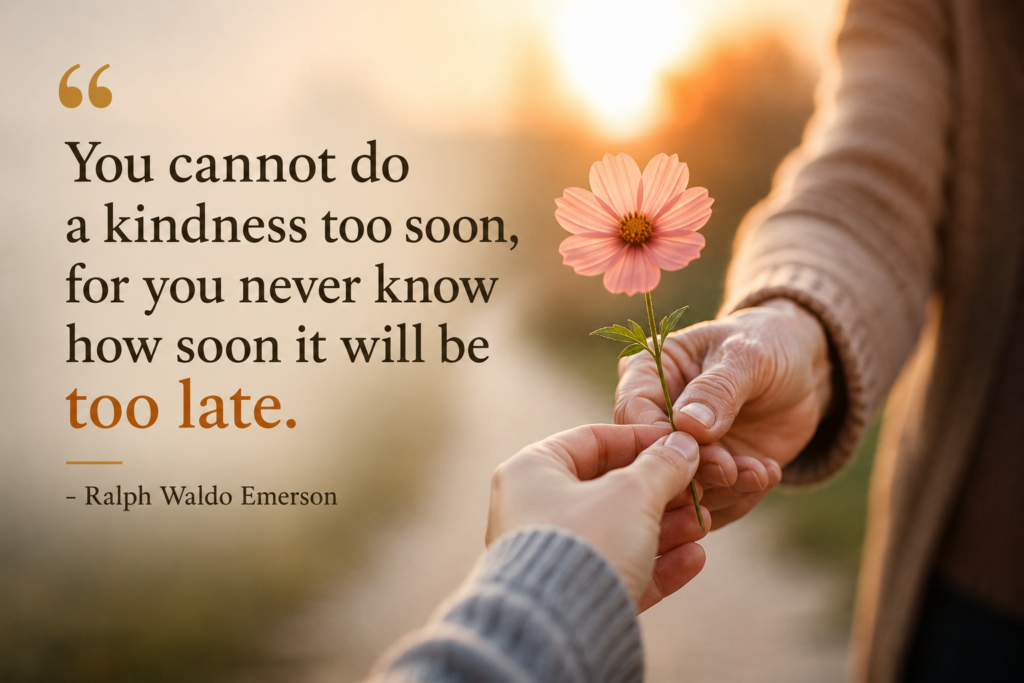
    “You cannot do a kindness too soon, for you never know how soon it will be too late.”
    — entity[“people”,”Ralph Waldo Emerson”,”American essayist and philosopher”]

    In a world moving faster than ever, kindness is often treated as something optional — something we will get around to later when we have more time, more money, or fewer worries. Yet Ralph Waldo Emerson’s timeless words remind us of a truth many people discover too late: opportunities to help others do not last forever.

    A kind word left unspoken. A phone call never made. A helping hand delayed until tomorrow. Life changes quickly, and the chance to bless another person can disappear in an instant.

    Today, kindness is not merely a pleasant virtue. It is a necessity.


    The Quiet Power of Simple Kindness

    Many people imagine kindness as grand gestures or dramatic acts of charity. In reality, the most powerful acts are usually the smallest.

    A smile to a lonely neighbor.

    Listening patiently to someone who feels forgotten.

    Paying for a stranger’s coffee.

    Helping a struggling small business survive one more week.

    Checking on an elderly friend.

    Praying for someone carrying hidden pain.

    These moments rarely make headlines, yet they often change lives forever.

    Kindness has a ripple effect. One act of compassion inspires another. A person who receives mercy is more likely to show mercy. Communities grow stronger when people choose generosity over indifference.

    In small towns across America, neighbors helping neighbors still keeps communities alive. Rural hospitals survive because caring people refuse to give up. Families overcome hardship because someone stepped in at the right moment.

    Often, the difference between despair and hope is simply knowing that somebody cares.


    Why Waiting Can Cost More Than We Realize

    Modern culture teaches people to postpone what matters most.

    “We’ll visit later.”

    “We’ll donate when finances improve.”

    “We’ll reconnect someday.”

    But tomorrow is never guaranteed.

    Every person carries unseen battles. Some struggle with loneliness. Others face illness, grief, financial hardship, addiction, or fear. Many smile outwardly while quietly losing hope.

    A timely act of kindness may arrive at the exact moment someone is deciding whether life is worth continuing.

    History is filled with stories of lives transformed by one compassionate moment:

    • A teacher who encouraged a discouraged child.
    • A stranger who offered food to a hungry family.
    • A nurse who stayed a few extra minutes beside a frightened patient.
    • A pastor who answered a late-night phone call.
    • A veteran who mentored a troubled teenager.

    The people involved may never fully know the impact they made.

    That is the mystery of kindness: small actions often produce eternal results.


    Kindness Is Not Weakness

    Some people confuse kindness with softness or naivety. In truth, genuine kindness requires courage.

    It takes strength to remain compassionate in a cynical world.

    It takes humility to serve others without seeking recognition.

    It takes wisdom to see the humanity in people society overlooks.

    And it takes faith to keep loving when life becomes difficult.

    Kindness is not passive. It is active goodness.

    It feeds the hungry.

    It comforts the grieving.

    It protects the vulnerable.

    It rebuilds communities.

    It restores dignity.

    Throughout history, societies have survived hardship because ordinary people chose compassion over selfishness.

    In times of economic uncertainty, social division, and growing loneliness, kindness may be one of the most revolutionary things a person can practice.


    Faith, Humanity, and the Call to Love One Another

    Across many spiritual traditions, kindness is viewed as sacred.

    In Christianity, believers are reminded to love their neighbors, care for the poor, and treat others as they themselves would wish to be treated.

    Kindness reflects the belief that every person possesses inherent dignity and worth.

    Even brief encounters matter. The cashier at the grocery store. The exhausted waitress. The veteran standing quietly alone. The struggling single parent. The resident in a nursing facility who rarely receives visitors.

    Each person carries a story.

    Each person matters.

    Sometimes the greatest ministry in life is simply showing up for another human being.

    A visit.

    A prayer.

    A meal.

    A conversation.

    A moment of compassion.

    These things may appear small on earth, but they echo far beyond what we can see.


    Five Ways to Practice Immediate Kindness Today

    1. Reach Out to Someone You Have Been Thinking About

    Do not wait for the perfect time. Send the text. Make the call. Visit the person. Your outreach may mean more than you realize.

    2. Support a Local Small Business

    Many family-owned businesses are struggling quietly. A purchase, positive review, or recommendation can help sustain livelihoods and preserve communities.

    3. Encourage Someone Publicly

    People remember encouragement for years. Speak life into someone who feels invisible.

    4. Volunteer Where the Need Is Greatest

    Homeless shelters, rural ministries, food banks, hospitals, and veteran organizations constantly need caring people willing to serve.

    5. Practice Daily Compassion

    Hold the door. Listen without interrupting. Offer patience instead of irritation. Small habits of kindness shape both individuals and nations.


    Final Thoughts

    Ralph Waldo Emerson understood something deeply human: opportunities to love others are temporary.

    No one reaches the end of life wishing they had shown less compassion.

    The world does not simply need more technology, wealth, or influence. It needs more people willing to act with kindness before the moment passes.

    A gentle word.

    A helping hand.

    A compassionate heart.

    These simple acts can change lives, strengthen communities, and restore hope in places where darkness has settled.

    So do not wait.

    Offer the kindness today.

    Because you never know how soon it may be too late.

    Click Here to learn how to spread the Kindness Virus https://kindnessvirus.com/video/?ref=6HD 0IFGMirus

    Rick
    thmjmj@gmail.com

  • My Life is My Message

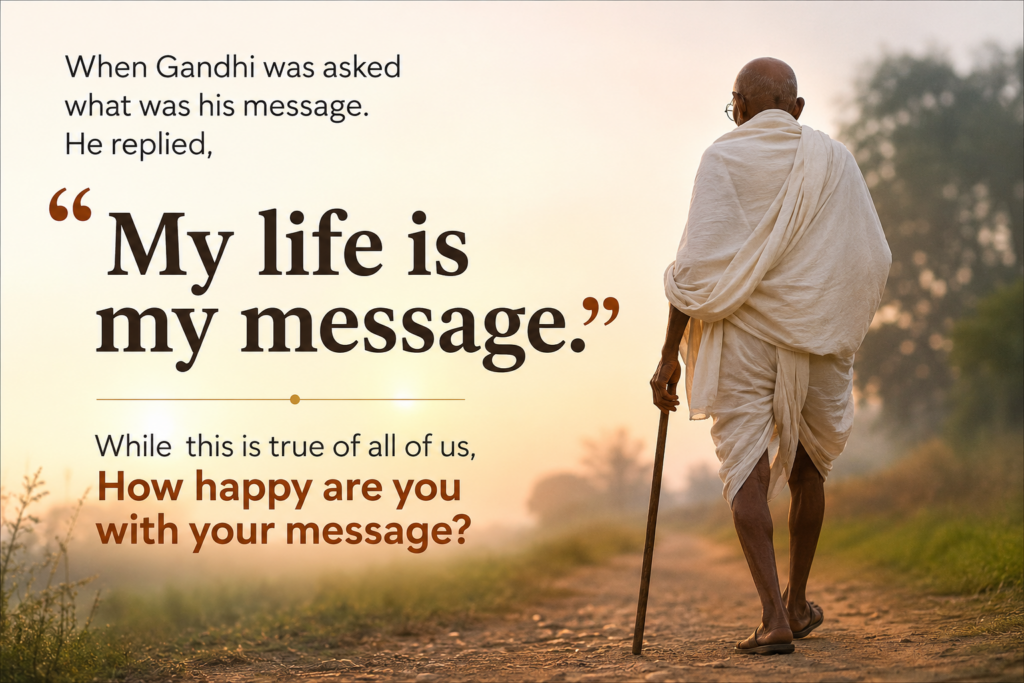
    When Mahatma Gandhi was asked what his message to the world was, he answered simply:

    “My life is my message.”

    Few words have ever carried such depth.

    Gandhi understood something many of us spend our entire lives trying to learn: our true message is not found in what we say, but in how we live. Our actions speak louder than our intentions, louder than our opinions, and often louder than our prayers.

    Whether we realize it or not, every one of us is sending a message to the world every single day.

    The question is: how happy are you with your message?

    Not the message you post online.
    Not the image you try to project.
    But the message your daily life reveals.

    What does your life say about what you truly value?

    Does it say kindness matters?
    Does it say people matter?
    Does it say faith, honesty, compassion, and love are worth living for?

    Or does it reveal something else entirely — fear, anger, selfishness, pride, or indifference?

    These are uncomfortable questions because they force us to look honestly at ourselves. It is far easier to talk about goodness than it is to live it consistently.

    Most people want to be remembered well. They want their lives to mean something. Yet meaning is not created in grand moments alone. It is built quietly in everyday choices.

    In how we treat the waiter.
    In how we speak to family.
    In whether we forgive.
    In whether we help someone who cannot repay us.
    In whether we choose bitterness or grace.

    A life becomes a message one decision at a time.

    The beautiful thing is this: no matter what your message has been up to now, you can begin changing it today.

    A harsh person can become gentle.
    A selfish person can become generous.
    A lonely person can become a source of encouragement.
    A wounded person can become a healer.

    Every sunrise offers another opportunity to live differently.

    Saint Francis of Assisi is believed to have said, “Preach the Gospel at all times. When necessary, use words.”

    The world does not only need more opinions. It needs more living examples. More people whose lives quietly radiate peace, integrity, humility, and love.

    Your life may never be written about in history books. Most of ours will not be. But every life leaves fingerprints on other people. Every conversation, every kindness, every act of patience or cruelty echoes farther than we imagine.

    Someone is learning from your life right now.

    A child.
    A friend.
    A stranger.
    A neighbor.
    Perhaps even someone silently struggling.

    What message are they receiving?

    At the end of our lives, people will not remember most of the words we said. They will remember how we made them feel. They will remember whether our presence brought light or darkness, hope or discouragement, peace or conflict.

    “My life is my message.”

    Perhaps the real challenge is not admiring Gandhi for saying it, but asking ourselves if we are willing to say the same.

    And if not today, what must change so that one day we can?

    Click Here is a way to make the message of your life truly dianamic and change the world begining with you.

    Rick

    thmjmj@gmail.com

  • Together we Grow

    To build Community we must share. We must care for those around us. To be a blessing we must truly be a blessing.

    You are my community. We truly have a community of love and sharing, joy and peace. The time has come to add a sustainable income source so we can help those that have no income. Those that are struggling. Those that need a helping hand. a hand up.

    This is the community we are building. A community where we share, care, lift up, become one with God our Father. To be fill with and guided by the Holy Spirit.

    “The Lord hears the cry of the poor.” Psalm 34: 6
    Together we can build a community that has the resources to reach, while building our resources, our email list, our income.

    These are just a few of the short Bible verse videos I ha ve posted on YouTube and other social media. Many are getting over 100 views their first day.

    To be part of that community, click Here.

    Thank you for reading and watching. Please share with others.

    Rick Herring
    thmjmj@gmail.com