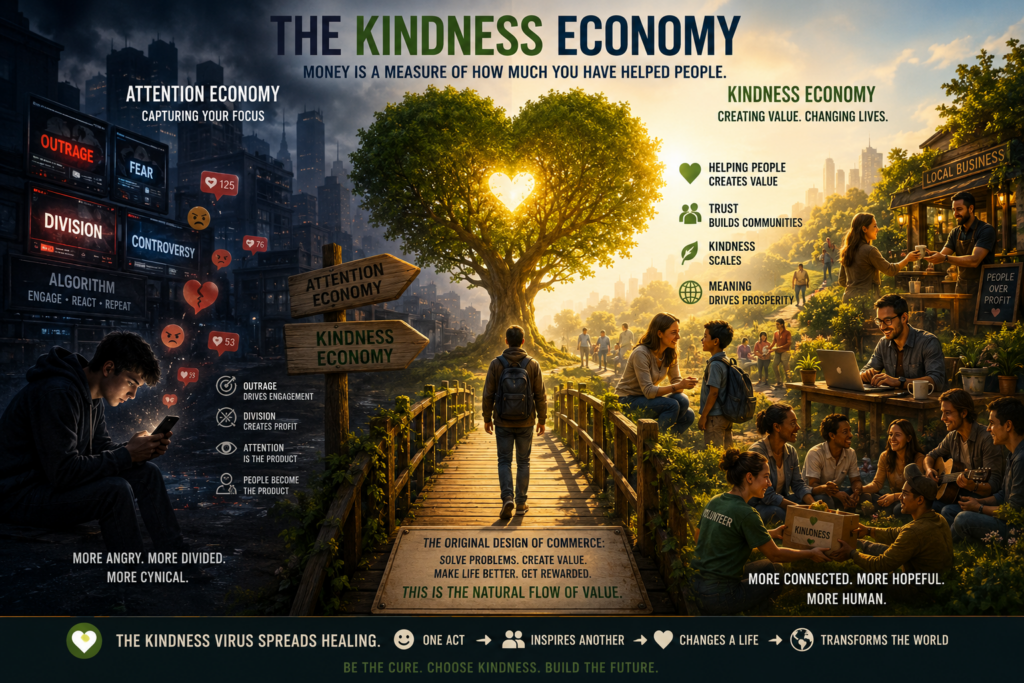
We live in what economists and cultural critics call the Attention Economy — a system in which the most valuable resource is not oil, not gold, not even money, but human attention. Every notification, every headline, every scrolling feed is competing for a single scarce commodity: our focus.
The largest companies in the world have built trillion-dollar empires on this principle. Social media platforms, streaming services, advertisers, and news outlets all profit by keeping us engaged for as long as possible. But there is a problem built into the system: outrage captures attention faster than peace. Fear spreads more quickly than hope. Anger generates more clicks than kindness.
And so the digital world has slowly trained itself to reward negativity.
The result is all around us. People are exhausted. Communities are fragmented. Public discourse often feels less like a conversation and more like a battlefield. The algorithms do not necessarily ask what is true, beautiful, or healing. They ask what will keep people reacting.
But at the edges of this system, something extraordinary is beginning to emerge.
A growing number of people are discovering another way to create value — and another way to earn a living. They are building businesses, communities, and movements not around outrage, but around encouragement, service, creativity, and compassion. They are participating in what might be called the Kindness Economy.
The Kindness Economy begins with a radical but deeply human idea: money is, at its best, a measure of how much you have helped people.
In its purest form, money is not merely compensation for suffering through work you hate. It is not simply a scoreboard for competition. It is the applause that society gives you for making someone’s life better.
When you solve a problem, people reward you.
When you create beauty, people support you.
When you make others feel seen, heard, valued, and less alone, they remember you.
This is not idealism. It is the original foundation of commerce itself.
A farmer grows food that feeds a village. A carpenter builds homes that shelter families. A teacher shares wisdom that changes a child’s future. In every healthy economy, value flows toward those who improve life for others. The Kindness Economy simply restores that principle in a world that has become distracted by spectacle and division.
What makes this moment unique is that technology — the very thing that intensified the Attention Economy — also makes the Kindness Economy possible on a global scale.
Today, one person with sincerity and a smartphone can encourage millions. A small business can thrive by genuinely serving its customers instead of manipulating them. Independent creators can build loyal communities by teaching, uplifting, and inspiring. People no longer need permission from giant institutions to spread goodness. They can do it directly.
And remarkably, kindness scales.
A harsh comment may travel fast, but encouragement travels deep. Cynicism may dominate headlines, but hope changes lives. Every act of generosity creates ripples that move outward through families, friendships, neighborhoods, and entire communities.
This is why kindness is not weakness. It is infrastructure.
A society cannot survive on outrage alone. Trust, cooperation, compassion, and goodwill are forms of social capital every bit as real as financial capital. When they disappear, communities collapse into loneliness and suspicion. But when they grow, human flourishing becomes possible again.
The Kindness Economy recognizes that helping people is not separate from prosperity — it is the foundation of lasting prosperity.
This is where the idea of the Kindness Virus becomes so powerful.
Unlike a biological virus, the Kindness Virus spreads healing instead of harm. One act of compassion inspires another. One generous person gives others permission to be generous too. A smile changes a mood. Encouragement changes a day. Mercy can change a life.
And like all contagious things, kindness multiplies through contact.
The world tells us that competition is the natural law of human existence. But history tells a more complete story. Human beings survived not merely because we competed, but because we cooperated. Civilization itself was built through acts of trust, sacrifice, teaching, caregiving, and shared labor.
The future may belong not to those who capture the most attention, but to those who create the most meaning.
Already, we can see signs of this shift. Customers are choosing businesses that treat people well. Audiences are seeking authenticity over manipulation. Young entrepreneurs increasingly want purpose alongside profit. Communities are hungry for leaders who heal rather than divide.
People are tired of being treated like data points.
They want to be treated like human beings.
The Kindness Economy is not naïve about the existence of evil, greed, or conflict. It simply recognizes that negativity is ultimately unsustainable. Fear may produce short-term engagement, but kindness creates long-term loyalty. Outrage may generate clicks, but trust builds civilizations.
In the years ahead, the most valuable people may not be those who dominate the loudest conversations, but those who help others feel less afraid, less isolated, and more hopeful.
That is not just moral wisdom.
It is economic wisdom.
Because in the deepest sense, wealth has always been relational. The strongest societies are not merely the richest societies. They are the societies where people believe they belong to one another.
The Kindness Economy invites us to build that kind of world again.
One act of service at a time.
One person at a time.
One moment of kindness at a time.
Click Here to become part of the Kindness Economy.
Rick
thmjmj@gmail.com
Leave a Reply